
As Goes Mississippi So Goes Tennessee?
Posted: June 24, 2013 Filed under: Politics Leave a comment The Atlantic over the weekend ran a piece by Molly Ball, its staff writer covering national politics, enticingly titled Can Democrats Win Back the Deep South? “Less far-fetched than you think” is the answer featured in the subhed and developed in the piece, which takes as its starting point a handful of elections in Mississippi earlier this month in which Democrats won mayoral victories in Republican strongholds. Dem wins in Meridian, Ocean Springs, Starkville and Tupelo had state Democratic Party Chair Rickey Cole trumpeting gains in fund-raising, technology, and ground game, and optimistically concluding that “we are seeing the healthy maturation in Mississippi to a two-party system.” The acid retort from one Republican partisan quoted by the Jackson Clarion-Ledger: “If I was a member of a party that only held one of our eight statewide offices, I would look for victory wherever I can, too.”
Ball’s Atlantic piece ponders the implications of Mississippi’s recent “Blue Tuesday” for the broader possibility of a de-crimsoned South:
A handful of local elections in Mississippi is hardly a blue wave. But Democrats across the South hope what just happened there is the start of something big — the first ripple of a Democratic comeback in the Deep South….A Democratic comeback will be a tall order, to say the least, in a region whose political story in recent decades has been a steady march toward the GOP. “It’s hard to conceive we could go any farther down,” chuckled Don Fowler, the South Carolinian who chaired the Democratic National Committee in the 1990s and is now chairman of South Forward. “But where can you find a place where a new Democratic thrust would be more welcome and could do more good?”
Ultimately Ball settles on the popular theme of demographic destiny as the basis for optimism that a blue South might rise again. As the map below illustrates, southern states are among those with the nation’s fastest-growing Latino populations. Combine that with growth in African-American numbers as well and you have some southern states headed for majority-minority status in the not-too-distant future (Georgia and Mississippi within a decade at current rates of growth, according to the Atlantic piece).
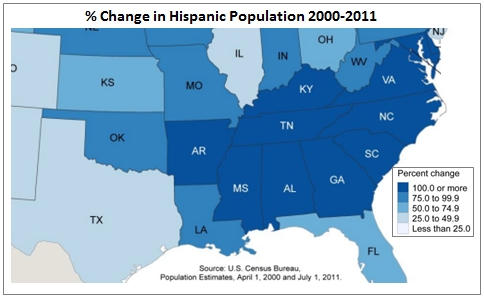
But growth is one thing; actual population is another. Although the map above puts us right there with other southern states in Latino population growth, Tennessee’s markedly lighter blue profile in map below (compared to the Carolinas and Georgia) suggests that Tennessee may be slower than some other southern states to reap the political effects of these demographic developments.

Ball points to newly organized groups pushing a trans-regional strategy aimed at electoral gains for southern Democrats. One is South Forward, a PAC that describes its mission as fostering “an integrated, multifaceted approach to revitalizing and growing the Democratic South.” By multifaceted they mean not just raising money for federal office seekers, but also doing candidate and campaign-management training, as well as providing direct support for down-ballot races.
Another is The Southern Project, an effort launched at last year’s Democratic National Convention in Charlotte that sums up its mission this way:
Driven by changes in demographics, [the South] has over the past few election cycles shown increasingly Progressive tendencies. Accordingly, Project New America — which was formed five years ago as Project New West by Western leaders, thinkers, and strategists as a tool to interpret and exploit the values and attitudes driving two decades of dramatic growth in the West — has now turned its resources and expertise to the South.
These kinds of organized efforts are important. Changing demographics may open opportunities for Democrats across the South, but as the Clarion-Ledger‘s analysis of what made Mississippi’s Blue Tuesday possible reveals, the things that win elections are, as ever, good candidates, lots of money, tactics, data, social media, and ground game. For that you need serious organization, not just favorable trends in census data.
A version of this post appears on the Nashville Scene‘s Pith in the Wind blog.
BoA: What We Stand For
Posted: June 17, 2013 Filed under: Corporations Leave a commentFrom ProPublica, a headline that tells us everything we need to know about why large corporations generally, and financial institutions specifically, have such a hard time cultivating consumer trust:

Bank of America employees regularly lied to homeowners seeking loan modifications, denied their applications for made-up reasons, and were rewarded for sending homeowners to foreclosure, according to sworn statements by former bank employees.
The modus operandi:
Sometimes, homeowners were simply denied en masse in a procedure called a “blitz,” said William Wilson, Jr., who worked as an underwriter and manager from 2010 until 2012. As part of the modification applications, homeowners were required to send in documents with their financial information. About twice a month, Wilson said, the bank ordered that all files with documentation 60 or more days old simply be denied. “During a blitz, a single team would decline between 600 and 1,500 modification files at a time,” he said in the sworn declaration. To justify the denials, employees produced fictitious reasons, for instance saying the homeowner had not sent in the required documents, when in actuality, they had.
Also this:
Five of the former Bank of America employees stated that they were encouraged to mislead customers. “We were told to lie to customers and claim that Bank of America had not received documents it had requested,” said Simone Gordon, who worked at the bank from 2007 until early 2012 as a senior collector. “We were told that admitting that the Bank received documents ‘would open a can of worms,’” she said, since the bank was required to underwrite applications within 30 days of receiving documents and didn’t have adequate staff.
And of course the inevitable denial:
In a statement, a Bank of America spokesman said that each of the former employees’ statements is “rife with factual inaccuracies” and that the bank will respond more fully in court next month.
It all fits elegantly with BoA CEO Brian Moynihan’s “What We Stand For” declaration: “Our purpose is clear. We are here to make the financial lives of those who do business with us better.”
College Republicans on Winning Back Young Voters
Posted: June 5, 2013 Filed under: Politics Leave a comment The newest addition to the Republican party’s post-2012 festival of post-mortem-handwringing-and-charting-the-way-forward is one worth spending some time with: a College Republican National Committee report focusing on what it labels the GOP’s “generational challenge.” As the report notes, Barack Obama waxed Mitt Romney among voters under age 30 last November by 5 million votes, a more than 20 percentage point advantage.
Rejecting “conventional wisdom..that young people naturally favor Democrats” and noting that Presidents Reagan and W. Bush did much better with young voters, the CRNC report’s authors declare that “the Republican Party has won the youth vote before and absolutely can win it again.” Incidentally, this thing wasn’t actually written by actual college Republicans; it was penned principally by a political consultant-slash-cable-news-mouthpiece for hire in her late twenties.
The report has promise as meaningful analysis because it draws significantly on data, including a new CRNC-commissioned survey of young voters, a 2012 Harvard Institute of Politics study of young Americans’ attitudes, other polls and some focus groups. But it runs to more than 90 pages, and the CRNC requires your email address to receive a copy (unless, like me, you know someone willing to give her email address and then forward it on). So as a public service, I read the report so you don’t have to.
There are three threads to the report’s analysis of where Republicans go wrong with young voters: technology, policy and branding. Let’s hit some highlights in each area.
The discussion of technology is erected on a perceived GOP deficit compared to Democrats in “understanding the media consumption habits of a new generation.” This part of the report should alarm Republicans, not because it is inaccurate, but because it suggests a party still struggling to keep up with the times. Consider these passages:
Programs like The Daily Show and the emergence of a variety of popular online news sites offer new ways to reach Millennial voters.
New in 2004 maybe. Really, you are only now figuring this out?
The data strongly suggest Facebook as an absolutely critical source of information…Young voters are not just consuming information from Facebook, they are often participating in the
conversation there.
You need to hire a consultant to surface this insight?
[Facebook/Twitter] posts that inspire strong emotions are more likely to be shared than those that fail to generate much emotional reaction.
Duh.
Text messaging is enormously common … with 62% saying they text multiple times per day (with “multiple times per day” in italics for astonished emphasis).
You think? And by the way what does it mean to engage in texting that is not multiple times per day? Who sends one single text per day?
A good Pandora ad is one that reaches the listener with a message that matters personally.
People respond more to ads that matter to them than ads that don’t matter to them? So that’s why we lost the election!
The technology section does arrive at the legitimate conclusion that mastering social media as a political tool requires “getting people to share, not just consume, your message” to improve reach with young voters. The problem, though, is that this is social media 101, and since it was also social media 101 four years ago, the analysis feels creaky and dated.
Moving on…
The report’s treatment of policy works from an assumption that “there are subjects where the Millennial generation and Republican Party are not in perfect agreement.” The GOP challenge is “persuading young people to agree with their policy positions on enough items to win their votes.”
Some of the survey and focus group data informing this section are interesting. On the economy, we learn that young people aren’t all that enthusiastic about Obama’s performance, but they do give him credit for at least trying to improve the situation, and they have no sense that Republicans would do better. This judgment that something beats nothing extends to other issues: “Young voters simply felt the GOP had nothing to offer, and therefore said they trusted the Democratic Party more than the Republican Party on every issue tested.”
You see this something-beats-nothing dynamic especially clearly on health care. Although the writers of the report do a lousy job concealing their fervent wish that young voters would hate Obamacare as much as they do, they are forced to concede that the data show young voters regard basic health insurance as a right by a two-to-one margin, and “the general sentiment seemed to be that at least Obama had attempted to change things.” It is refreshing to see actual Republicans openly admit that they have offered essentially nothing of substance on health care: “The advantage that Obama has on the issue is largely due to the fact that he attempted a reform plan at all.” Baby steps.
Things run a bit off the rails when it comes to student loan debt. The data are clear: young voters think Democrats are addressing the student loan crisis and Republicans aren’t. But instead of making the obvious point that Republicans need to change their approach, the report urges Repubs to embrace fringe remedies like Rick Perry’s $10K B.A. and more lending in the for-profit educational market.
There are some other interesting issue-oriented findings. While we all assume that young people are more environmentally engaged than older voters, the data show that young’ns are no more inclined to prioritize the environment over economic growth, nor to use instruments of public policy to do something about climate change. Nor do young voters prioritize immigration policy more than older voters, although they are more apt to support paths to legal status for the children of immigrants.
On social issues, young voters are just about as likely to be pro-life vs. pro-choice as the general population — an interesting factoid. But the report then loses all touch with reality by completely misrepresenting both GOP and Democratic positions on abortion: “Unfortunately for the GOP, the Republican Party has been painted — both by Democrats and by unhelpful voices in our own ranks — as holding the most extreme anti-abortion position (that it should be prohibited in all cases).” I assume that by “unhelpful voices” they mean their own national party’s platform! With equal suspension of disbelief, they sum up the Democratic party’s position as “pushing for abortion to be legal in all cases and at all times.” Earth to GOP: You are not going to win back young voters on this or any other issue by denying the black-letter reality of your own position and twisting the opposition’s into something outlandish and unrecognizable.
On LGBT issues the report comes clean: “Young people are unlikely to view homosexuality as morally wrong, and they lean toward legal recognition of same-sex relationships.” Its authors concede that “gay marriage was a reason that many of these young voters disliked the GOP.” But rather than offer up the obvious remedy — change the party’s fundamental orientation on an issue whose ultimate outcome is clear and inevitable — the report calls on the GOP to “promote the diversity of opinion on the issue within its ranks.” I’d call this the “we’re not all bigots” strategy. Yeah, that’ll work.
And to the last of our three threads…
The branding challenge is summed up this way: “Is it any wonder…that young people reject the GOP when its message is being carried in such a negative and out-of-touch way?” In the CRNC’s focus groups, young voters describe the Republican Party as closed minded, rigid, and old-fashioned. The Democratic Party evokes adjectives like tolerant, diverse, and open-minded. Okay, that’s unsurprising.
It gets more interesting when discussing how young survey respondents define themselves aspirationally — identifying attributes that they hope others see in them. According to the report, young people want to be thought of as smart and competent more than what conventional wisdom would have us believe — that young people wish to be regarded as cool, creative, unique and tolerant. I suspect the report’s authors are over-interpreting their data, but that’s okay because it does drive them toward a conclusion that is important both for their party and, frankly, for the good of the republic: that smart is good and stupid is bad. Being thought of as closed-minded is not a good thing, they observe, adding that “if the GOP is thought of as the ‘stupid party,’ it may well be the kiss of death.”
This is good stuff because it is high time that the Republican Party begin to move away from the anti-intellectual impulses of its conservative wing, and the CRNC report appropriately calls this out as a generational concern. (Just the other day influential right-wing blogger Erick Erickson bloviated that conservatism “does not win when it is academic or technocratic.”) Neither party has cornered the market on intelligence, the report declares, and while that may at times seem open to debate when the volume is turned up on some of the GOP’s fringe voices, it is ultimately to everyone’s benefit if the Republican Party works to re-engage its rational self.
To sum up, the CRNC report is worth a look, but there is an overarching problem with many aspects of the way forward envisioned by the document: its framing of the GOP’s need for fine tuning to appeal to young voters simply doesn’t square with how actual Republicans are actually behaving. In a Daily Caller piece marking the report’s release, the principal author along with the chair of the CRNC write that “we’ve been mislabeled the ‘party of no’ … the truth is that we aren’t just the ‘party of no’ … this isn’t about being obstructionist or anti-Obama.” This doesn’t even pass the smell test. The home page of the same CRNC that makes this claim prominently features a video called “The Great Pretender” depicting Obama as a cartoonish imperialist star-fucker with “no shame” who is “laughing while we’re going down” and flushing the country down the toilet (complete with toilet imagery). Right. Not reflexively anti-Obama. Got it.
Democrats certainly have no automatic lock on young voters and shouldn’t take them for granted, and the CRNC report is justified by the obvious concern that a party that doesn’t connect across generations is a party without a future. Even so, Republicans are going to have to do a lot better than technological amateurism and vapid self-delusion if they want to turn the generational tide.
A version of this post appears on the Nashville Scene‘s Pith in the Wind blog.
NY Times Column Misconstrues Prisoner’s Dilemma
Posted: June 3, 2013 Filed under: Economics Leave a commentThe business writer James B. Stewart’s Saturday New York Times column took a fascinating look at the situation facing a former hedge fund portfolio manager charged with insider trading who now must decide whether to cooperate with prosecutors. Stewart writes that the manager’s situation is akin to the classic game theory problem known as a prisoner’s dilemma (PD). To be sure, it’s a tricky dilemma that this fellow faces, and it resembles a PD, but unfortunately Stewart inaccurately describes the nature of a PD, and also confuses its meaning with imprecise language about “cooperation.”
The definition of a PD in the piece is incorrect. Stewart writes:
In the now-classic version, the police have arrested two suspects and are interrogating them in separate rooms. Each can either confess and implicate the other, or remain silent. If only one confesses, he goes free and the other gets a harsh sentence. If both confess, each gets a reduced sentence, but still goes to jail. If neither confesses, the government lacks the evidence needed to convict and both go free.
This misrepresents the canonical PD structure, which has a payoff for cooperating with the other suspect (staying silent) that needs to be less than (not equal to) the payoff for defecting (confessing) if other suspect cooperates (stays silent). To put it another way, the payoff for solo defection has to exceed the payoff for mutual cooperation. But in the Times piece Stewart describes the “classic version” as a situation where suspect goes free if both stay silent, and goes free if only he confesses. Those are equivalent outcomes – “goes free.”
In PD structure terms (this graphic from the Wikipedia entry on PD),

T has to be greater than R. This is not a trivial problem. By having T=R (as Stewart suggests), any temptation to defect is removed – it never makes sense to defect. You could say it takes the D out of PD!
In addition to erroneously describing a classic PD, the piece is confusing because in the context involved – turning state’s evidence – Stewart understandably and repeatedly uses the word “cooperate” (as in: the guy will or won’t cooperate with prosecutors). But this leads to a problematic passage like this one:
Game theorists have demonstrated that the rational choice, or dominant strategy, is always to confess and implicate the other, even though the optimal outcome for both occurs if neither cooperates. That’s because, as Professor Picker explained, if one prisoner has confessed, the best the other can hope for is also to confess and get the moderate sentence rather than the harsher sentence reserved for those who don’t cooperate. If one prisoner doesn’t confess, the other can go free by implicating him. Although they collectively are better off if neither cooperates, their individual self-interest dictates cooperation.
The problem is that in the game theory/PD world, “cooperates” means stays silent (you cooperate with your fellow suspect; confession is defection). So when Stewart writes in the first sentence of this passage that “the optimal outcome for both occurs if neither cooperates,” he means cooperates with the prosecutor, not cooperates in the PD sense (stay silent). The last sentence in the passage sums it up correctly in terms of “cooperating” with the prosecutor, but wrongly in PD language – exactly the opposite is true in the cooperate/defect sense of PD.
A City’s Competitive Edge: Cheap Colonoscopies!
Posted: June 3, 2013 Filed under: Healthcare Leave a comment A New York Times piece Sunday on the absurdly high price of health care in the U.S. compared to other countries zeroed in on everyone’s favorite medical intervention — the colonoscopy — as a particularly compelling example. We learn in the piece that colonoscopies cost a lot more in the U.S. than in other developed nations, but we also learn that the cost varies widely within the U.S.
Nashville, it turns out, is clearly a destination of choice for the price-conscious colonoscopy chopper. An analysis by Healthcare Blue Book looking at the highest amount paid for the procedure shows Nashville among the lowest of various metropolitan areas examined. Compared to our number, the upper bound price is more than double in Atlanta, Chicago and Denver, and more than triple in Austin. Only Baltimore is lower, and while they do also overachieve as a city in the all-important crab cake category, let’s face it … who really wants to live in Baltimore?
The map tells the story:
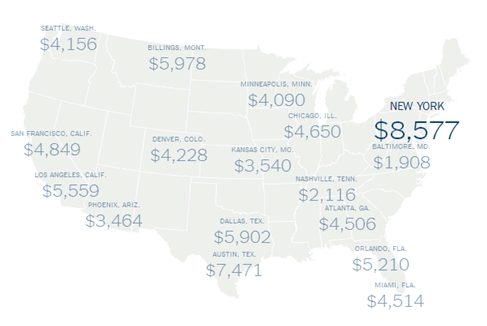
Each number is the highest amount paid for a colonoscopy in that metropolitan area.
Source: The New York Times
Finally, something Nashville does better than Austin! But can we leverage this competitive advantage? Colonoscopy tourism!
A version of this post appears on the Nashville Scene‘s Pith in the Wind blog.
Common Core: The Paranoid Right’s Latest Existential Threat to the Republic
Posted: May 6, 2013 Filed under: Education Leave a comment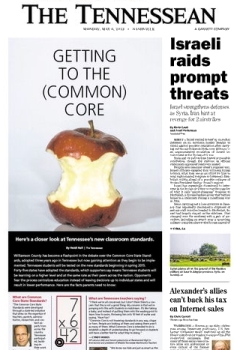 The Tennessean this morning devoted vast dead tree real estate to the Common Core standards that are reshaping public school curricula in Tennessee and 44 other states. Although these standards have been around for a while as states have been adopting them one by one (Tennessee did so three years ago), new testing coming in 2014 has put Common Core on the front burner, especially for opponents and skeptics. Last week hundreds of conservatives gathered at a Franklin hotel to hear speakers rail against Common Core. Indeed, many on the right have reached full-tilt froth mode at the looming horrors they see in Common Core, although figuring out the substance of their objections turns out to be a bit of shell game.
It should be acknowledged up front that Common Core is encountering some backlash from the left as well: Progressives are unhappy with new exams polluting an already toxic educational culture of standardized testing mania, and many teachers (and their unions) are worried that the implementation cart is being put ahead of the teacher-training horse.
But while liberals may be worried that the product is being rushed to market, so to speak, conservatives seem to think the product is itself an affront to civilization and human decency. So just what is the conservative beef with Common Core?
The Tennessean piece last week reporting on the Franklin gathering is unenlightening, offering only two sentences on the substance of opponents’ critique:
Opponents of Common Core accuse the Obama administration of dangling billions of dollars in Race to the Top funds to get states to sign on to its notion of what children should be learning. The opponents say that, rather than raise student achievement and accountability, it dumbs down academics and leads to data-mining of student information.
The first sentence is partially true: To be eligible to apply for Race to the Top funding, a state had to show “its commitment to adopting a common set of high quality standards,” and the way to do so is through “participation in a consortium of states…working toward jointly developing and adopting a common set of K-12 standards…that are supported by evidence that they are internationally benchmarked and build toward college and career readiness by the time of high school graduation” (source: Federal Register, 4/14/10, p. 19503). The Common Core, an outgrowth of an interstate consortium, is essentially the sort of thing being described here, although Race to the Top (quoting from its FAQ) “does not endorse any particular consortium or set of standards.”
The second sentence is outlandish. Whatever one thinks of the existence of national standards (a pretty good idea that happens to work out nicely in most advanced countries), you can’t look at the actual substance of Common Core and see in it a dumbing down of anything. I challenge anyone to review the Common Core standards document covering English, Social Studies, and Science and explain where this dilutes down anyone’s education. It is precisely because states including Tennessee were assessing student achievement so leniently that this whole thing emerged.
For more insight on what opponents are thinking I paid a visit to the Tennessee Against Common Core website, the home page of which blends a confusing attack on Bill Gates (who apparently “can buy whatever he wants, even our children’s minds”) with a curiously unhinged analogy between Common Core and Adolph Hitler’s ordering all children into government schools in 1937. Deeper on the site we encounter a 16-page PDF (cribbed with permission from Utah’s anti-Common Core group) telling us that Common Core is “the nationalizing and even globalizing of education.” Opponents see it as illegally establishing a national curriculum, even though anyone who bothers to actually look at the Common Core standards documents can see quite plainly that it isn’t a curriculum, and in any event no state is compelled to have anything to do with it.
It is true that federal law constrains the U.S. Department of Education’s ability to mandate curricula and assessments, but there is nothing mandatory here. Although the whole Common Core initiative is a voluntary thing among states, conservatives object to standards as a condition for Race-to-the Top funding — these “incentives have clouded the picture,” in the words of Iowa Senator Chuck Grassley and several of his GOP colleagues. This objection is nonsense. Federal money to states is routinely conditioned on policy expectations, and states are perfectly free to opt out and not apply.
At the end of the day the conservative backlash against Common Core feels like yet another case of right-wing anti-intellectual paranoia. As one commenter on the Stop Common Core in Tennessee Facebook page declares, “This is about federal take over and the state, teachers and parents giving up their rights to the feds. Federal government control = mind control.” Another: “If I wanted to live in a socialist/communist society I would have moved elsewhere…what happened to our Democracy!?”
Common Core may not be the magic bullet that will fix K-12 education in the country, but calling it out as a dire existential threat to the republic will accomplish even less — except perhaps demonstrate that opponents haven’t bothered to read the thing.
A version of this post appears on the Nashville Scene‘s Pith in the Wind blog.
In Stylish Colors for Boys and Girls
Posted: April 26, 2013 Filed under: Disgust Leave a comment
Backpacks too!
Actually we’re not likely to see mandatory bulletproof school uniforms anytime soon because it turns out they are a wee bit on the pricey side. But it is lovely to know that if you’ve got a thousand dollars to spare you can buy junior a kids ballistic puffer vest, which not only provides NIJ Level II ballistic protection (whatever the hell that means), but also comes in six “stylish colors for boys and girls” including fuchsia! There’s also a kids ballistic t-shirt for a cool $755 (white only, alas).
The head of the company that makes and sells this stuff, one AJ Zabadne, is quoted in the Guardian story describing his products as nothing more than a routine precaution: “It’s like you find life jackets on ships or planes in case they go down. It’s no different to having a seatbelt in a car.”
Yes, quite right, small children wearing thousand-dollar body armor garments to elementary school … the moral equivalent of a seat belt. Good lord.
A version of this post appears on the Nashville Scene‘s Pith in the Wind blog.


 BruceBarry.net