
Regulating Worker Speech Needlessly
Posted: August 19, 2013 Filed under: Employment, Free Speech 2 Comments A Washington Post op-ed last week tells the story of a woman who decided to quit her job at a physician’s office because her employer wouldn’t let her keep a hoodie image as her computer desktop’s wallpaper. Brenda Howard had selected the image as a show of support for Trayvon Martin’s family in the wake of the Zimmerman trial. She writes of the boss’s disapproval:
On Aug. 1, at the end of a long work day, my boss called me into his office. Apparently, during the two weeks since I had selected the hoodie image for my computer desktop, some of my co-workers had complained. They felt that this image, which could be seen only when I logged in or minimized all the windows open on my screen, was inappropriate. My boss, looking distressed, told me that I had to change it.
There was no room for discussion between him and me or me and them. There would be no way to explain, to anyone who felt frightened or threatened by what I had done, that I wasn’t making some call to arms, or a black-power salute, or in fact trying to express any anger at all. It was merely an image of a piece of clothing worn by a young man who was wrongfully killed. By displaying it, I was simply saying that I was sad.
Obviously the boss’s position is legal — an employer gets to decide what is or isn’t displayed in a work space, including on the desktop of an office computer. But just because an employer can regulate expressive activity doesn’t mean it must do so. Howard’s situation is precisely the kind of overreaction I had in mind when I wrote about managerial regulation of expression in my book on the First Amendment and the workplace:
It isn’t all that hard to think of situations where employee expression poses a genuine threat to legitimate employer interests, and a functional free-enterprise system need not require employers to tolerate speech of that sort. It’s alarming, however, when people are punished on the job not because their speech concretely jeopardized employer interests, but because their actions trigger needless employer fears about the effects that might possibly occur. We have built in the American economy a management culture so dependent on predictability and control that even remote “threats” to the established order are treated with suspicion and dealt with harshly. The American legal systems of employment law and corporate governance largely excuse employers from worrying about how their actions square with constitutional values or human rights.
Howard writes in the op-ed that she left the meeting with her boss knowing “that he had every right to ask me to take it [the image] down, but I would not have respected myself if I had.” A silly managerial decision needlessly put a long-term employee in an untenable situation, all over the simple matter of harmless personal expression.
A version of this post appears on the Nashville Scene‘s Pith in the Wind blog.
Reality (TV) is Merely an Illusion
Posted: August 16, 2013 Filed under: Media Leave a comment Last night on the season premiere of AMC’s “The Pitch,” the Nashville advertising and communications firm Fletcher Rowley, best known for its work in political consulting, competed against some mooks from Atlanta for an account with College Hunks Hauling Junk. CHHJ, which recently expanded into the moving business (College Hunks Moving, which doesn’t have quite the same ring to it), has been experiencing what its president calls a brand “identity crisis,” and so went looking for ad agency help rethinking its overall approach to branding. Enter reality TV’s “The Pitch.”
The hour-long AMC show follows the two competing agencies firms through their internal creative processes, culminating in oral presentations — the pitches — made to the client firm’s leadership. Fletcher Rowley proposed that CHHJ lose the “college hunk” concept and completely rebrand as Heroic Movers and Haulers. The Atlanta agency, a capitalization-challenged firm called breensmith (adding to the edginess: a shaved head guy in charge and a woman with pink hair on the team), suggested keep the CHHJ brand for the hauling side of the business, and brand the moving side as Hunks and a Dolly. After the two pitches, the agency types stand around in the hallway (with far less trash talk than this demanding viewer would have liked to see) while the client firm’s executives make their decision. They summon the agencies back in and announce the result: breensmith gets the gig. A crushing defeat for the home team.
But wait: within a few minutes after the show’s credits roll FR’s Bill Fletcher tweets the all-important denouement:

Fletch and Rowley expanded on this in a TwitLonger post:
Now that you have seen the show you know that it looked like we “lost” during the actual filming. Truth is, a few days later filming completed the College Hunks Hauling Junk and College Hunks Moving guys reached out to us and, ultimately, they hired us instead of the firm they selected on the show. It’s a cautionary tale about some of the limitations of non-scripted television because if it doesn’t happen when the cameras are rolling then it didn’t happen. We had hoped that AMC and the producers might put a note to that effect at the end of the show but we understood when it was made clear to us that the show was edited and locked and they couldn’t make any changes. We were fine with that decision as long as we could tell the rest of the story after the show aired and that’s what we’re doing now.
You’ll encounter no evidence of this real reality outcome on the breensmith twitter feed or anywhere that I could find on the AMC show’s website. Reality, as Einstein said, is merely an illusion, albeit a persistent one.
A version of this post appears on the Nashville Scene‘s Pith in the Wind blog.
Banning Grades of ‘Zero’ from Schools
Posted: August 5, 2013 Filed under: Education 2 Comments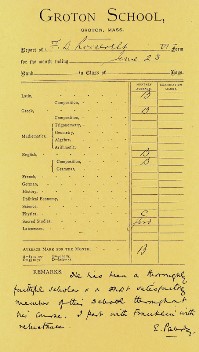 A City Paper story last week reported on the move by Metro Nashville Public Schools to eliminate zero as a score on assignments, with 50 percent now becoming the lowest “F” grade a high school student can receive. The story elicited the whining one might expect from commenters about the dumbing down of education. Wrote one: “That is exactly what is wrong with our schools. So students who do not turn in an assignment still get half credit for doing it, even though they did nothing?” Another: “This is the most asinine policy I’ve ever heard. I thought child raising was moving away from everyone gets a trophy.”
In this case the school system has it right, and the whiners have it wrong. The reason isn’t pedagogy or tolerance for mediocrity or compassion or trophyism; it’s simple math. It is mathematically inane (and unethical) to grade on a 100 point scale and use zero as the marker of failure or non-performance.
Assume, for instance, that one connects percentage grades with letter grades by having 90 mark the dividing line between A and B, and 80 for B/C, 70 for C/D, 60 for D/F. (I don’t know that MNPS systematically uses these dividing lines but they are likely in the ballpark of how most people think about grades on a 100% scale.) Giving a zero on something throws into the student’s average a number for failing performance that is lower than the distance between C and D by a factor of five. It makes no sense to do that. One has to earn 150 on another assignment just to balance the the failure to achieve an average of 75.
Think about the 4.0 grade point average (GPA) scale common in higher education and some secondary schools. That scale makes sense because grade values of 4 (for an A), 3(B), 2(C), 1(D), and 0 are arithmetically equidistant, and because the number assigned for failing performance and non-performance is the same: zero. In linear mathematical terms, giving a student a zero on a 100-point scale where 60 is otherwise the D/F dividing line (so let’s call 55 a straight-up F) is the equivalent of giving a student graded on a 4.0 scale a grade point value of -5.5 and then averaging it in with all the other scores that range from 0.0 to 4.0.
The use of 100-point grading scales has always been idiotic for this reason, unless the teacher curves or concatenates the bottom end of the available range so that the lowest possible score (somewhere in the 50s, presumably) is in sync with the magnitude of steps across the overall range of grades. MNPS’s “let’s bottom out at 50” policy accomplishes this, making the system smarter, not dumber.
A version of this post appears on the Nashville Scene‘s Pith in the Wind blog.
Elect the Tennessee AG?
Posted: July 8, 2013 Filed under: Law, Media Leave a comment The Tennessean editorialized Sunday in favor of popular election of the state attorney general. Tennessee is one of just seven states that don’t elect the AG, and the only state where the AG is chosen by the judiciary (by the Tennessee Supreme Court). In five of the other six states the governor appoints the AG, and in one state the legislature appoints.
Yesterday’s editorial represents a bit of a shift for the daily fishwrapper:
In the past, the editors of this newspaper have praised Tennessee’s status as the only state whose chief lawyer is chosen by the judiciary branch. But the world changes, and with it our expectations. In this era of ever-more-divisive government and heightened risk of corruption through big, anonymous campaign contributions, some priorities have shifted — although not those that matter most: fairness and the belief that the will of people should prevail. In other words, it’s time for voters to get fully involved in how the state of Tennessee is run, and that means popular election of its attorney general, as is the case in 43 states.
Putting aside the editorial’s clumsy attempt to justify a change in position with vapid assertions about “ever more divisive government” and “heightened risk of corruption,” they do reach the right conclusion: the AG should be elected. Many of my liberal fellow travelers will stridently disagree. They defend the current system as one that breeds the appointment of intelligent moderates who privilege legal analysis over ideology, keeping the AG’s office out of the hands of rabid conservatives who might win a statewide election. True that, but do the ends justify the means?
I think not. An elected AG is compelled to advocate with vigor for the people who put him or her in office, which offers the prospect of a more assertive watchdog over popular interests in realms of consumer protection and corporate malfeasance. Some will say, “but the nutter who might win popular election in deep red Tennessee won’t do those things.” Maybe, maybe not, but deciding whether an office should be elected or appointed on the basis of the expected electoral result is both bad public policy and bad democracy. And by the way, the current arrangement does represent an intractable conflict of interest — the Tennessee Supreme Court appointing the state’s chief law enforcement officer, who manages an office that routinely does business in that and other courts on behalf of the state.
There is another argument not mentioned in the Tennessean editorial: we also should elect the AG because we need more statewide elective offices. It is not a good thing that U.S. Senators aside, the election for governor is the only statewide race we have. The lieutenant governor should be elected as well. The parties need more opportunities to develop political bench strength in the heat and light of statewide races.
The current AG, Bob Cooper, is by all accounts a thoughtful human who, given an elected AG, could well be replaced with someone less measured and more ideological. I probably won’t be happy at all with the newly elected AG, and the constructive role that AG legal opinions have played in recent years tempering some of the worst impulses of the legislature will likely diminish. But those are reasons to try to win an election, not reasons to have no election at all.
A version of this post appears on the Nashville Scene‘s Pith in the Wind blog.
The Bigoted Stylings of Justice Alito
Posted: June 26, 2013 Filed under: Law Leave a comment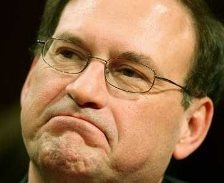 The U.S. Supreme Court’s exciting final day of the term was highlighted by its 5-4 ruling tossing most of the insidious Defense of Marriage Act onto the dustbin of constitutional history. Much of the gravity in the three separate dissents penned by conservative members of the Court — John Roberts, Antonin Scalia and Samuel Alito — was technical having to do with standing and jurisdiction rather than with the equal protection merits.
But beyond the technical issues, Alito and Scalia did take the opportunity in their dissents (pdf) to tell us how they really feel about marriage equality. Alito in particular went off the rails. Here are some excerpts from the world of equality according to Sam Alito:
It is beyond dispute that the right to interracial marriage is not deeply rooted in this Nation’s history and tradition…Past changes in the understanding of marriage—for example, the gradual ascendance of the idea that romantic love is a prerequisite to marriage—have had far-reaching consequences. But the process by which such consequences come about is complex, involving the interaction of numerous factors, and tends to occur over an extended period of time. We can expect something similar to take place if interracial marriage becomes widely accepted. The long-term consequences of this change are not now known and are unlikely to be ascertainable for some time to come. There are those who think that allowing interracial marriage will seriously undermine the institution of marriage… Others think that recognition of interracial marriage will fortify a now-shaky institution. At present, no one—including social scientists, philosophers, and historians—can predict with any certainty what the long-term ramifications of widespread acceptance of interracial marriage will be…The Members of this Court have the authority and the responsibility to interpret and apply the Constitution. Thus, if the Constitution contained a provision guaranteeing the right to marry a person of a different race, it would be our duty to enforce that right. But the Constitution simply does not speak to the issue of interracial marriage.
Ok, he didn’t quite write that … I changed “same-sex” to “interracial” and “a different race” where underlined. But otherwise he wrote exactly that. The Supreme Court figured out 46 years ago in Loving v. Virginia — a unanimous ruling — that in equal protection terms Alito’s kind of logic applied to interracial marriage won’t fly: “The Fourteenth Amendment requires that the freedom of choice to marry not be restricted by invidious racial discriminations.” Polls now show most Americans believe in that sentence even with the word “racial” removed. The Alitos out there will eventually be dragged into the twenty-first century (or should I say the late 1960s).
A version of this post appears on the Nashville Scene‘s Pith in the Wind blog.
The Hypocritical Stylings of Justice Scalia
Posted: June 26, 2013 Filed under: Law Leave a comment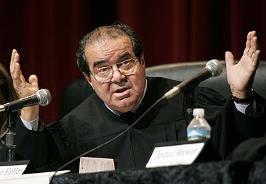 Say what you will about affirmative action, voting rights, same-sex marriage, the Supreme Court as an institution … but as the Court wraps up its term with today’s final decisions, we pose the question on everyone’s mind: Is there a bigger hypocrite than Justice Antonin Scalia in all of American jurisprudence?
Scalia’s ability to twist his reasoning and his opinions to suit the outcomes he apparently prefers is legend. Not sure where he stands on waterboarding, but his inclination to torture a legal argument until it confesses his desired conclusion has been in full bloom these last two days, with the Court’s rulings on the Voting Rights Act and the Defense of Marriage Act.
Today, writing in dissent (pdf), Scalia excoriated the majority that ruled DOMA unconstitutional for elevating the Court’s judgment over the prerogative of the legislative branch. Bloviate away, Nino:
That is jaw-dropping. It is an assertion of judicial supremacy over the people’s Representatives in Congress and the Executive. It envisions a Supreme Court standing (or rather enthroned) at the apex of government, empowered to decide all constitutional questions, always and everywhere “primary” in its role.
Yet just yesterday Scalia signed on to Chief Justice Roberts’ majority opinion eviscerating an act of the people’s representatives in Congress. Roberts’ opinion complained that “Congress did not use the record it compiled” when it reauthorized the Voting Rights Act. Congress’ continued reliance on VRA’s prior preclearance formula is an act of “irrationality.” We are left “with no choice but to declare [VRA] section 4b unconstitutional” because Congress chose not to update the formula.
In the DOMA dissent today Scalia was eager to point out that the presence of any legitimate justification for a duly enacted statute removes the need for Court review. He wrote of DOMA: “There are many perfectly valid—indeed, downright boring—justifying rationales for this legislation. Their existence ought to be the end of this case.” Does anyone doubt that there were many perfectly valid rationales for Congress’ 2006 reauthorization of the Voting Rights Act? Even the Roberts majority — which Scalia signed on to — recognized that the country has made great strides because of VRA and acknowledged that there can still be a role for VRA as a whole and preclearance in particular.
When it comes to Antonin Scalia’s approach to legal reasoning, the ends don’t just justify the means; they define them. The result is quiet acquiescence in judicial activism — Congress must be stopped! — in order to rein in voting rights, but indignant horror at the evils of judicial overreach — We must defer to Congress! — when it comes to equal protection.
A version of this post appears on the Nashville Scene‘s Pith in the Wind blog.
SCOTUS on Voting Rights: Dueling Metaphors
Posted: June 25, 2013 Filed under: Law Leave a comment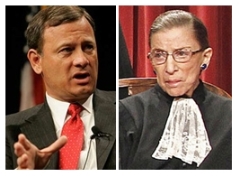 The U.S. Supreme Court rendered today its highly awaited ruling on the Voting Rights Act, finding 5-4 that the Act’s preclearance mechanism is in theory acceptable but in practice unconstitutional. In an opinion (pdf) penned by Chief Justice Roberts, the five conservatives on the Court reasoned that the preclearance provision is “irrational” because it relies on a “formula based on 40-year-old facts having no logical relation to the present day.” In dissent, the Court’s liberal justices respond that there is plenty of connection between the Act’s history and the present: “second-generation barriers to minority voting rights have emerged” in the jurisdictions covered by the Act, replacing those original barriers (like poll taxes and literacy tests) that justified preclearance in the first place. This, Justice Ginsburg’s dissent argues, amounts to “powerful evidence” that preclearance “remains vital to protect minority voting rights.”
This is all important stuff, sure, but my favorite aspects of the decision and the dissent are the dueling metaphors contained within. Who has the better one? You make the call.
First a bit of background: When Congress last reauthorized the Voting Rights Act in 2006, it kept in place without modification the existing formula for determining which states and jurisdictions remain subject to the requirement that changes in voting procedures must be precleared by the Justice Department or a federal court. It is Congress’ failure to update the coverage formula that leaves the Court “no choice but to declare section 4(b) unconstitutional,” Roberts wrote. With a better, presumably less irrational formula, preclearance is still acceptable. The Court could have invalidated the entire concept of preclearance, as the Alabama county that brought the lawsuit asked, but only Clarence Thomas was willing to go that far.
So preclearance survives conceptually, but is essentially moot unless and until Congress can legislate a more up-to-date formula for deciding which states and counties are affected. That might seem doable given that when Congress reauthorized the Act in 2006 it did so with huge majorities in both parties. But in today’s increasingly polarized legislative environment, getting a new voting rights preclearance formula through Congress seems (metaphor alert) like an uphill battle to say the least.
Now on to the Supreme metaphors! Let the battle commence.
First up is the majority opinion, tackling a claim by the dissent that Alabama’s Shelby County, which brought the suit, lacks standing to challenge the Act because Shelby itself is a place where voting discrimination has been documented. Roberts swings the metaphorical bat:
That is like saying that a driver pulled over pursuant to a policy of stopping all redheads cannot complain about that policy, if it turns out his license has expired.
Now to the dissent, attacking the majority for underplaying what it calls “volumes of evidence” supporting Congress’ determination in 2006 that backsliding was a realistic prospect. You’re up, Ruth Bader Ginsburg:
Throwing out preclearance when it has worked and is continuing to work to stop discriminatory changes is like throwing away your umbrella in a rainstorm because you are not getting wet.
I like Roberts’ simile because it succinctly and colorfully captures the argument he is trying to make, although it is technically flawed by irrelevancy. There is no conceptual link between hair color and license validity, whereas in the voting rights case, we are talking about related things: Shelby County’s empirical record of voting discrimination (the expired license) and the county’s objection to voting discrimination rules in force (the stop-all-redhead policy). Even so, a nice one; I give Roberts a B+.
Ginsburg’s umbrella simile is clumsier because it doesn’t capture the essence of her argument as neatly, and actually distorts its target — the other side’s claim. For its many flaws (and there are many), the majority opinion does not deny that preclearance has worked and can continue to work. The Court’s ruling doesn’t throw away the umbrella, though it does declare use of the umbrella off limits until its design is improved. Also a good one, but Ginsburg only rates a B.
On the merits I find the dissent more compelling, although only slightly so. The majority opinion’s logic is stronger in many respects, but its legal foundation is suspect. But logic and legalities — those are just sideshows. The metaphors are the main event — and on that stage … a narrow win for Roberts and the conservatives!
A version of this post appears on the Nashville Scene‘s Pith in the Wind blog.


 BruceBarry.net