
NSA In Perspective
Posted: January 21, 2014 Filed under: Civil Liberties Leave a commentMany on the left have spent the last few days processing the president’s speech last week on NSA reforms and trying to figure out if this is (finally) evidence that Obama is turning a corner on surveillance, security, and privacy. Good perspective on this comes, as usual, from Glenn Greenwald, writing last Friday in The Guardian:
And now we have the spectacle of President Obama reciting paeans to the values of individual privacy and the pressing need for NSA safeguards. “Individual freedom is the wellspring of human progress,” he gushed with an impressively straight face. “One thing I’m certain of, this debate will make us stronger,” he pronounced, while still seeking to imprison for decades the whistleblower who enabled that debate. The bottom line, he said, is this: “I believe we need a new approach.”
But those pretty rhetorical flourishes were accompanied by a series of plainly cosmetic “reforms”. By design, those proposals will do little more than maintain rigidly in place the very bulk surveillance systems that have sparked such controversy and anger.
GG does point to some positive developments: FISA court reform, less control over national security letters, distancing NSA from control of metadata, and the diminished inclination to spy on leaders of friendly nations. But on the whole it is sad but true that he can reach this justifiable conclusion: “Those who want genuine changes should not look to politicians, and certainly not to Barack Obama, to wait for it to be gifted.”

Labor Rights and Wrongs
Posted: December 9, 2013 Filed under: Economics, Employment 1 Comment An op-ed in this morning’s Tennessean by my friend and Vanderbilt colleague Dan Cornfield calls elected officials in Tennessee to account for their vocal opposition to unionization at Volkswagen’s Chattanooga plant. Cornfield is alluding, presumably, to comments from the likes of Gov. Bill Haslam, who responded back in March to reports of UAW involvement at VW that “I would hate for anything to happen that would hurt the productivity of the plant or to deter investment in Chattanooga.” And to Sen. Bob Corker, who in September said that allowing the UAW into VW’s Tennessee plant would make the company a “laughingstock in the business world.”
Turns out we already have many of these laughingstocks, as Cornfield points out:
The public officials’ claims that unionization hinders Tennessee’s economic development are at best unmindful of the positive economic impact of these corporations. Many large, private Tennessee employers have union collective bargaining agreements with some or all of their employees, including Alstom Power, AT&T, Bridgestone, Carlex, CSX, FedEx, Ford Motor Co., General Motors, Kroger, Lear, Medical Action Industries, Norfolk Southern, St. Francis Hospital, Sharp Manufacturing, Southwest Airlines, Tyson Foods, UPS and Voith.
To Cornfield’s argument about “the positive economic impact of unionized corporations on the prestige and growth of the sate economy,” I would add that we’re talking about basic labor rights here. Haslam, Corker, and their fellow anti-union travelers seem to need reminding that collective bargaining is a fundamental human right codified in Article 23 of the Universal Declaration of Human Rights (which of course the U.S. helped draft and voted to adopt over half a century ago):
Everyone has the right to form and to join trade unions for the protection of his interests.
Elected officials who are ignorant of basic rights are far more likely to make the state a “laughingstock” than the exercise of those rights by working Tennesseans.
A version of this post appears on the Nashville Scene‘s Pith in the Wind blog.
Lamar Filibusters Reality
Posted: November 25, 2013 Filed under: Politics Leave a comment Seeking to fend off a tea-party primary challenger, Sen. Lamar Alexander has been warming up for 2014 by rebranding himself as hostile to the kind of pragmatic moderation that once framed his centrist political persona. With an op-ed in the Washington Post late last week assailing the move by Senate Democrats to do away with the filbuster on executive and judicial nominations, Alexander demonstrates he is also working hard to rebrand himself as hostile to facts and reality.
The Post piece is a model of intellectual dishonesty. Alexander says Democrats built the change in Senate rules on “filmsy excuses, many of which are untrue.” Let’s look at two of them. Lamar writes:
Excuse No. 1: President Obama’s appointees have been unfairly denied seats by failed cloture votes, or filibusters. According to the Congressional Research Service, no Supreme Court nominee has been defeated by filibuster in the Senate … The number of federal district judge and Cabinet nominees defeated by filibuster? Zero. Regarding sub-Cabinet nominees, there were two for President Obama, three for George W. Bush and two for Bill Clinton. That’s it. … As for appeals court judges, Republican filibusters have blocked five, but that happened only after Democrats first blocked five.
The dishonesty here is in the phrase “denied seats by failed cloture votes, or filibusters.” A cloture vote is a vote to limit debate, which effectively ends a filibuster. But filibusters don’t always (or even usually) end in cloture votes one way or the other. By measuring filibusters as a count of failed cloture votes, Alexander is not only dissembling, he is doing exactly what the very Congressional Research Service report (pdf) he cites tells him not to do. According to the CRS, it is “erroneous” to equate cloture motion outcomes with filibusters:
Filibusters can occur without cloture being attempted, and cloture can be attempted when no filibuster is evident. Often today, moreover, it appears that Senate leaders generally avoid bringing to the floor nominations on which a filibuster seems likely. In such cases there are no means by which to identify the merely threatened filibuster.
Cloture votes don’t tally filibusters, the CRS goes on to say, because “a filibuster is a matter of intent; any proceedings on the floor might constitute part of a filibuster if they are undertaken with the purpose of blocking or delaying a vote.” So a better measure of GOP obstructionism regarding Obama’s nominees is found in delay – the amount of time nominees wait for confirmation.
Alexander takes up this angle … and once again mangles reality:
Excuse No. 2: President Obama’s nominees have waited too long for confirmation. According to the Congressional Research Service, Obama’s second-term Cabinet nominees have been confirmed at about the same pace as those of Presidents Clinton and Bush. This year, the Senate has confirmed 36 of Obama’s second-term nominees to circuit and district courts, compared with 14 for Bush at this point in 2005.
The distortion here is really basic. Exploring whether nominees “have waited too long for confirmation” by comparing the raw number of confirmed second-term Obama appointments with the number for Bush at same point in his term is nonsensical since it fails to account for differences in numbers of vacancies and says nothing about actual time nominees have waited for Senate action. Actual data on confirmation delays tell the story Lamar doesn’t want you to hear:
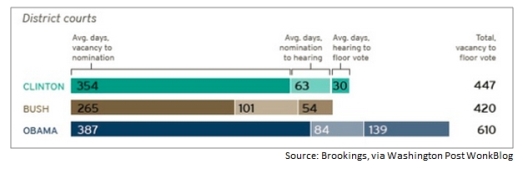
Reasonable people can disagree about the merits of a filibuster rule that empowers legislative minorities to slow confirmations of executive appointments. Unreasonable people (like Lamar Alexander) can torture the facts to invent a false argument about the effects of such a rule.
A version of this post appears on the Nashville Scene‘s Pith in the Wind blog.
Nothing Says Monday Like Bigotry in Congress
Posted: November 4, 2013 Filed under: Policy Leave a comment
“Federalism, dude.”
Lamar Alexander is already on record with his disdain for the rights of LGBT workers, as Politico reported last week:
Sen. Lamar Alexander (R-Tenn.), a bipartisan deal-maker who faces a primary challenge in his 2014 reelection bid, said the bill amounted to “too much federal overreach.” … “One of my guiding principles is federalism,” Alexander said. “I don’t think we need an additional federal law to regulate it.”
How refreshing — federalism as a pretense for bigotry! Where have we seen that dance before? Given that we already have federal law engaging in regulatory “overreach” with its ban on employment discrimination on the basis of race, color, religion, sex, and national origin, one must conclude that Lamar stands firmly for repeal of Title VII of the Civil Rights Act of 1964. Top that for GOP primary season unhingery, Joe Carr!
I can find no clear evidence of Sen. Bob Corker’s intentions on today’s vote, but in an op-ed over the weekend, Chris Sanders of the Tennessee Equality Project surmised that Corker won’t support ENDA either. Our two allegedly business-friendly senators might want to get on the same page with Apple CEO Tim Cook, who backs ENDA with the observation that “embracing people’s individuality is a matter of basic human dignity and civil rights.”
A version of this post appears on the Nashville Scene‘s Pith in the Wind blog.
My Last Marsha Post. Promise.
Posted: November 1, 2013 Filed under: Healthcare, Politics Leave a comment
“I demand to be taken seriously.”
Asserting that “some people like to drive a Ford and not a Ferrari, and some people like to drink out of a red solo cup and not a crystal stem,” Blackburn argued that people should be free to keep the cut rate insurance they have rather than be compelled to buy some of that highfallutin’ Marxist-Leninist Obamacare coverage. Sally Kohn at Salon captures it well, summing up Blackburn’s argument as a brief for the principle that “Americans should be free to hold onto their inadequate, costly and reckless insurance policies that throw them off at the slightest sign of illness while forcing costs up for the rest of us.”
Without question, this is to a significant extent a self-inflicted wound at the White House, which willfully enabled this latest tactical conservative assault on the Affordable Care Act through Obama’s repeated assertions going back three years that under ACA people could keep their existing health insurance if they wished. Although NBC News would have us be stunned by the revelation that the Obama administration knew this claim to be exaggerated, it was actually pretty obvious to anyone paying attention from the outset that ACA would compel many to encounter significant changes in health insurance coverage. A lot of us were cringing at Obama’s repeated assertions on this when he first started making them.
But that doesn’t impeach the imbecility of Blackburn’s way of “thinking” — that no health insurance policy exists that is too flimsy to meet the needs of her fine constituents. Look, she has every right to believe that health insurance should be a wholly unregulated market, but she needs to make the case for that, not just rail against regulatory standards merely because they are regulatory standards. Would she do away with all regulation of all insurance? Does she have even a clue as to the implications of doing so? If you want to use your Congressional perch to shout down administration officials with nostrums of free market liberatarian orthodoxy, it might behoove you and your staff to spent at least a few minutes understanding how these markets and regulatory schemes work, and what the actual policy consequences of doing away with them might look like.
Ok, for real this time: No more Marsha posts.
A version of this post appears on the Nashville Scene‘s Pith in the Wind blog.
Hatred for ACA: The Gift That Keeps On Giving
Posted: October 18, 2013 Filed under: Politics Leave a comment It’s no surprise that Republicans are spinning their strategic retreat on the shutdown and debt ceiling (“strategic retreat” being, of course, a polite euphemism for “abject surrender”) as something else. Who wouldn’t? It is curious, though, that in crafting the spin many on the right think that doubling down on hatred for Obamacare is the way to go.
Yes, ACAphobia was the spark that lit the fire, as the Wall Street Journal’s Jerry Seib aptly summarizes:
To the conservative rebels who brought on a government crisis their party’s elders never wanted, the point is simple: They wanted to demonstrate that they don’t simply oppose President Barack Obama’s signature health-care program, but find it so philosophically objectionable that they will fight it at every turn. To them, it isn’t merely a health program but the very symbol of a big-government philosophy that they find threatening.
These “rebels” now find themselves in the role of victims of the law of unintended consequences: not only did the effort to defund ACA fail entirely; as Seib points out it also “demonstrated definitively that the GOP today simply lacks the votes in Congress under any scenario to force meaningful changes to it.”
Undeterred by this new reality (or perhaps just impossibly optimistic), the spin on the right now holds that it’s only a matter of time before people really come to really see how really disastrous Obamacare really is. The dimwitted likes of Rep. Marsha Blackburn have been misreading polls on the public’s mind on this along. Now, with this month’s crisis averted, Erick Erickson at RedState advances the delusional ball:
The fight was always about Obamacare. Today we know we must keep fighting and fight harder against even our own supposed side … As more Americans watch Obamacare fail them through the Republican primary season, conservatives will be able to put the focus on Republicans who funded Obamacare instead of fighting it.
There’s a problem with this, a rather obvious one: people simply don’t dislike Obamacare as much as Marsha and Erick do, not nearly as much. A new Democracy Corps poll makes this clear yet again (pdf with toplines here).
This new poll does reveal, yes, that equal numbers favor and oppose ACA when asked that straight out (45-45 in this survey). But as in past polls, when you ask whether opponents think the law goes too far vs. not far enough, you end up with not much more than a third of respondents opposed to the law in the way that Marsha and Erick are. Even more telling: Asked whether “we should implement and fix the health care reform law,” or whether “we should repeal and replace the health care reform law” voters prefer “implement and fix” by a whopping 58-38% margin.
The ACA deadenders on the right are clinging to the belief that it’s just a matter of time before Americans wise up to the expensive and complex morass which is Obamacare. What they miss is that most people already understand that our dysfunctional system of health insurance is an expensive and complex nightmare that requires an expensive and complex remedy. Marsha needs to learn the difference between a feature and a bug.
A version of this post appears on the Nashville Scene‘s Pith in the Wind blog.


 BruceBarry.net