
Public and Private
Posted: June 22, 2012 Filed under: Pedagogy, Policy Leave a comment
Photo: RM Stringer (Creative Commons)
Times columnists Gail Collins and Paul Krugman both wrote op-ed pieces this week about the eagerness with which politicians seem to lust after the idea of privatizing public services. The timing is no coincidence; their interest was clearly piqued by the paper’s recent investigative reporting on New Jersey’s dysfunctional system of privately run halfway houses for prison inmates. As Collins points out, the impulse to privatize is one that crosses the political aisle, though perhaps not in equal measures:
Politicians of both parties are privatization fans, although the Republicans are more so. Mitt Romney has flirted with the idea of privatizing veterans’ health care. He goes steady with the Medicare privatization forces and is believed to be secretly married to the folks who want to privatize public education through the use of vouchers.
Krugman zeroes in on the potential for corruption when (as in New Jersey) the private companies involved cultivate deep connections with the politicians who are supposed to be working for us, not them:
Never mind what privatization does or doesn’t do to state budgets; think instead of what it does for both the campaign coffers and the personal finances of politicians and their friends. As more and more government functions get privatized, states become pay-to-play paradises, in which both political contributions and contracts for friends and relatives become a quid pro quo for getting government business. Are the corporations capturing the politicians, or the politicians capturing the corporations?
Between the stresses on public officials balancing difficult budgets and the voices of the energetic anti-government right, the question of how and when to privatize has become one of the fundamental issues of the day at the intersection of business and public policy. And that gets me asking, as a b-school professor, how we tackle this subject in management education. The answer: for the most pretty frivolously.
Business curricula are so caught up in technical training rooted in the functional areas of the firm (finance, accounting, marketing, operations, human resources, and the like) that the attention paid to matters of policy that span the boundary between firms and governments are treated as an afterthought, if at all. The market-focused ideology of U.S. business schools leads many within their walls to reflexively celebrate privatization and disdain regulation rather than think deeply about them. Your average b-school sees its mission as preparing graduates for gainful employment at (for instance) a firm that runs private prisons, not for deep engagement with the question of whether privatizing corrections is good public policy and beneficial for society.
A b-school dean might reply that someone wishing to engage deeply on that should head across campus and get a public administration or public policy degree; we’re here to equip our students with the tools they need to run these operations, not to question them existentially.
I think that’s wrong. Privatization isn’t something that business people should automatically favor any more than it’s something that big-government liberals should automatically oppose. When it works well it streamlines government and stimulates private sector economic activity — both good things. But when it doesn’t work it makes government less efficient and less effective (and possibly more corrupt), which harms business interests along with everyone else’s. There are things the private sector does better, and many things it doesn’t. Business people, like other humans, should be engaging in thoughtful conversation about this divide, not just sharpening pencils waiting on the sidelines to see what profit opportunities might emerge. We do our students a disservice if we don’t prepare them for that conversation.
A Zip Code? Really?
Posted: June 20, 2012 Filed under: Mysteries 1 CommentWhen the U.S. Attorney General writes a letter to the President of the United States, as he did yesterday on the matter of executive privilege in the “Fast and Furious” matter, why is it that the heading of his letter needs to include a zip code?
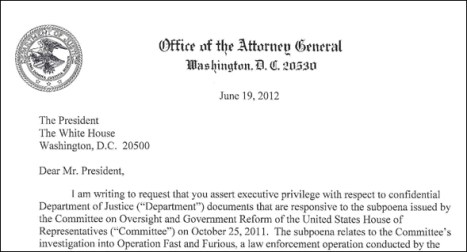
Is it not going to get there without a zip code? Is there a risk that the letter might end up at some other “The White House” in DC? It’s a mystery.
The Business of Governing
Posted: June 19, 2012 Filed under: Policy Leave a comment Michael Lind asks if we need a businessman in the White House:
At first glance, it might seem plausible that successful private sector leaders understand the modern national and global economies. But doing well in one part of the economy is quite different from understanding what is good for the economy as a whole …. Running an economy that is good for business is radically different from running a business, in a number of ways.
Agreed, although Lind undersells the important point that “running an economy” is not the president’s responsibility. The temptation by the Mitt Romneys of the world to say, essentially, “I’d be a good president because I’ve run businessy stuff” misconstrues the job as predominantly managerial. Yes, a president does have to manage the organization that is the White House, and preside over the large bureaucracy we know as the executive branch, and there is ample evidence that these aren’t Barack Obama’s strong suits.
But in terms of the impact of a presidency, these are small parts of the gig compared to big picture matters of policy and diplomacy, which bear virtually no resemblance to the kind of experience one gets wearing a suit in the private equity world. Given an ideologically neutral choice for president (or governor or mayor) between an intellectually nimble, thoughtful person who grasps the nuances of policy, diplomacy, and political philosophy, and a competent, pragmatic alternative who knows his or her way around a boardroom, I’ll take the egghead every time.
Lind also wonders, if business types would do so well, why there have been so few:
The vast majority of American presidents have been career politicians, who moved up in state politics before aspiring to a national stage. And most presidents who worked in the private as well as the public sector were lawyers, not corporate managers or investors.
This analysis is less successful: equating the rarity of a thing with its merits might work in the rare gemstone trade, but as argument goes it falls short of the mark. Given rather limited evidence that our system results in the election of outstanding political leaders, it makes little sense to draw inferences about ideal qualifications from the attributes of those who have held office in the past.
Moral Capitalism?
Posted: June 18, 2012 Filed under: Ethics, Pedagogy 1 Comment
Under the headline “Can’t a Capitalist Be Moral?,” U. of Chicago business school professor Luigi Zingales writes at Salon.com that firms are unable to create better market systems, so it is left to business schools to “lead the effort to impose some minimal norms for business – norms that discourage behavior that is purely opportunistic even if highly profitable.” Zingales goes on to suggest that b-schools engage in more overt disapproval of actions that compromise healthy markets in the long run:
Asking business schools to stigmatize all behavior that does not maximize welfare would be absurd. They shouldn’t be expected to shame or criticize a company for using the market power that it has legitimately acquired … [or] … for taking advantage of the tax loopholes present in the system ….There is a difference, however, between taking advantage of existing tax loopholes and lobbying aggressively to have those tax loopholes created or expanded. What about marketing policies targeted to prey on addiction or to induce young customers to smoke? Is making money the only metric we should reward and admire in business leaders?
Zingales is making a reasonable although hardly original observation about the teaching role of business schools in relation to the purpose of the firm and a given market. Where he ends up is with a strikingly minimalist assessment of b-school ethics classes (I teach one of those animals at Vanderbilt) that locates them in two piles:
Some classes simply illustrate ethical dilemmas without taking a position on what people are expected or not expected to do. It is as if students were presented with the pros and cons of racial segregation, leaving them to decide which side they wanted to take. Other classes hide behind corporate social responsibility, saying that social obligations rest on firms, not individuals
Teaching an ethics class to people in their late twenties with professional experience (the prototypical MBA student at well-regarded b-schools) is not appropriately framed as an attempt to make students “more ethical” by telling them what to do and not do in specific situations. Instead, and what Zingales misses in his simplistic caricature, a reasonable goal for an ethics course involves giving students tools (analytical, lexical, and contemplative) that improve their abilities to recognize and decipher the moral content in situations and to generate options that are rooted in ways of thinking about that content.
Sure, I want my students going forward to make more ethical decisions as managers and executives, but I want them to do so because they recognize the presence of an ethical dimension to some particular context, and can draw on informed notions of moral reasoning to work their way through the situation. This we can and do teach in business schools, some of us anyway.
Statistical Homicide
Posted: June 17, 2012 Filed under: Policy Leave a comment This post appeared on the Nashville Scene‘s Pith in the Wind blog.
In a Tennessean op-ed last week on the proposed budget for Nashville and the tax increase it contains, local businessman Nathan Massey made a statistical claim that more money for policy officers reduces crime:
Let’s look at crime statistics. There were 51 homicides in Nashville in 2011. That is the lowest number of homicides since 1966. That suggests a direct relationship between investment and return.
I won’t comment on the merits of the budget or the tax hike,* but I can put on my social scientist hat (or striped shirt, to upgrade the metaphor) and referee the merits of a statistical argument. And on the matter of a lower number of homicides supporting a relationship between investment and return I’m throwing yellow flags: extremely illegal procedure.
Massey’s factoid may be accurate — the number of homicides has receded to the terrority it occupied back in the 1960s — but the meaning of those numbers is anything but clear. If you want to understand trends in violent crime, murder is perhaps the least reliable thing to look at. It is well understood that drops in raw homicide numbers can be explained in significant measure by advances in medicine and technology that make victims of attempted murder likely to survive. A landmark 2002 study, “Murder and Medicine,” published in the academic journal Homicide Studies (and who doesn’t want a subscription to that next Christmas?) showed that it’s not violent assaults that dropped over the last four decades of the twentieth century — nationally the rate of aggravated assault quintupled! — but rather the lethality of assaults. The study (summarized by the NIH here) found that but for the dramatic drop in trauma mortality, murder rates by the turn of the century would have been much higher than they were.
A glance at long-term trends in violent crime in Nashville (using the FBI’s Uniform Crime Reporting statistics, synthesized for Metro Nashville here) bears out this skepticism about the meaning of a drop in homicides. Looking at rates of violent crime in Davidson County, rather than numbers, we find that while, yes, the murder rate (per 100,000 population) has dropped by more than a third since the mid-1960s, rates of aggravated assault, rape, robbery, and violent crime overall have more than doubled. On an upbeat note, though, these rates have noticeably backed off their peaks during the 1990s.
As a New York Times writer put it at the time the “Murder and Medicine” study came out, we “aren’t any less murderous — it’s just getting harder for us to kill one another.” It is, by extension, statistical malpractice to use long-term trends in the raw number of homicides as evidence either for or against the efficacy of law enforcement spending.
*No can do, owing to spousal unit on Metro Council who will vote on the thing.
To Begin With
Posted: June 16, 2012 Filed under: Miscellany Comments Off on To Begin WithLaunching this site to replace my old one.


 BruceBarry.net