
“Faith” Drives “New” Political Movement
Posted: July 9, 2012 Filed under: Politics, Religion Leave a comment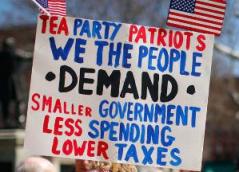
…and slavery?
A front page piece in today’s Tennessean (the daily here in Nashville) riffs off the recent publication of a book by a Christian broadcaster to explore the Tennessee presence of “Teavangelicals,” defined as “politically active conservative Christians.” The piece, headlined “Faith Drives New Political Movement,” highlights a group called the 9.12 Project Tennesseeand quotes its organizer J. Lee Douglas (who indicates he’s never heard the word “Teavangelical” but let’s not let that get in the way).
Reporter Bob Smietana conveys Douglas’s predictable far-right nostrums: government debt is immoral, same-sex marriage is sinful, and healthcare reform is unconstitutional. (That last one does seem a little tangential to the Biblical vibe, though perhaps there is some piece of the New Testament I haven’t seen that covers the commerce clause.) What Smietana doesn’t do in the piece is tell us how thoroughly retrograde the 9.12 Project Tennessee really is, to judge from its website:
We’re committed to the late 18th century American values of equal application of the law for all men and women with privilege for none.
By “late 18th century values” related to “equal application of the law,” we have to assume that the 9.12 Project Tennessee is amenable to reviving a society in which only free white men with property can vote and in which slavery is legal. Moreover, since one of the group’s core “9 principles” holds that “my spouse and I are the ultimate authority, not the government,” we might infer that the 9.12 Project Tennessee regards filicide as morally and legally acceptable.
The first of their principles reads, “America is good.” So a good American is free to own other humans as property and kill one’s offspring? One shudders to think what would make America “great.” Memo to Tennessean editors: It’s usually a good idea to look a little deeper at a fringe group one plans to feature on the front page of the paper.
This post appeared on the Nashville Scene‘s Pith in the Wind blog.
Best Paying One-Day Job Ever
Posted: July 6, 2012 Filed under: Corporations, Disgust Leave a comment
Photo: brokinhrt2 (Creative Commons)
Those who justify exorbitant levels of CEO pay as functional examples of how markets work will perhaps have a tough time explaining the strange case of Bill Johnson and the Duke Energy Corporation. Johnson signed a contract last week to become Duke’s chief executive upon closure July 2 of a merger with Progress Energy Inc. (which Johnson had previously led). The merger took effect on July 2, and Johnson resigned as CEO at 12:01 am on July 3. A company spokesman says the hasty (to say the least) departure was by “mutual agreement,” and nobody else is talking.
But what we do know is that a half a day’s employment can be very, very lucrative. Let’s just quote from the Wall Street Journal‘s account:
Despite his short-lived tenure, Mr. Johnson will receive exit payments worth as much as $44.4 million, according to Duke. That includes $7.4 million in severance, a nearly $1.4 million cash bonus, a special lump-sum payment worth up to $1.5 million and accelerated vesting of his stock awards, according to a Duke regulatory filing Tuesday night. Mr. Johnson gets the lump-sum payment as long as he cooperates with Duke and doesn’t disparage his former employer, the filing said. Under his exit package, Mr. Johnson also will receive approximately $30,000 to reimburse him for relocation expenses.
“As long as he doesn’t disparage his former employer.” That’s precious. Why on earth would he do that? Apologists for executive compensation like to argue that astronomical pay can’t be avoided “because if I don’t pay them, someone else will.” I look forward to their application of this theory to the strange case of Duke Energy and Mr. Johnson.
Supremes on Medicaid: “Loaded Gun”?
Posted: July 3, 2012 Filed under: Healthcare, Policy Leave a comment
Although the insurance mandate gets most of the attention, many believe that it’s the Supreme Court outcome on Medicaid expansion within ACA that could have the longest lasting impact. Stanford professor Pamela Karlan wrote in last Sunday’s Times that the Roberts court ruling on Medicaid contributes to a neutering of federal power that should have liberals worrying big time:
For the first time since the New Deal, the court struck down an exercise of Congress’s spending power. It held that Congress lacked the power to deny Medicaid funds to states that refuse to expand their coverage. Chief Justice Roberts — joined by the liberal justices Stephen G. Breyer and Elena Kagan — held that while the government can deny additional Medicaid funds to states that refuse to expand their coverage, it cannot penalize them by rescinding current Medicaid payments. This is a loaded gun indeed.
Prof. Karlan notes that this is just the latest in a string of rulings curbing federal power, with cases coming down the pike next term on voting rights, affirmative action, same-sex marriage, and environmental affairs giving the Court opportunities to chip away further.
Without discounting Prof. Karlan’s conclusion that the trend at the Court gives “Americans who care about economic and social justice a reason to worry,” I do think after reading the Roberts opinion and the Ginsburg dissent carefully that she overstates a bit the ruling’s logic and argument on Medicaid (though granted, not the effect!). The Court held that the federal government can penalize states by rescinding current payments if the expansion is modest and incremental rather than radical. There is a fundamental difference of opinion between Roberts and Ginsburg over whether this particular expansion is modest or radical. To use the language in their back and forth in their opinions, is it a difference in kind (Roberts) or degree (Ginsburg)? Personally I’m inclined to side with Ginsburg and Sotomayor on this point, though it isn’t necessarily a simple or straightforward call.
It’s fascinating that this aspect of the case split the liberal wing of the Court — with Kagan and Breyer joining Roberts to find that it’s a difference in kind, not degree, and accordingly conclude that its overly coercive on the states. Perhaps they genuinely bought the Roberts formulation that the Medicaid expansion really is a difference in kind. But I am guessing that what tilted them might have been Roberts’ willingness to keep the ruling narrow — to say that the finding of undue coercion on the states invalidates only the threat to revoke all Medicaid funding to a state that rejects the new funding and conditions, but doesn’t (as the Scalia/Kennedy/Alito/Thomas cabal would have) invalidate the whole kit-n-kaboodle. Of course, Ginsburg and Sotomayor expressly at the end of their dissent bought into that limiting principle regarding what gets invalidated, making it possible for that narrow effect to prevail (otherwise the whole thing would could have been tossed). The coalition dynamics on the Court were fascinating on the Medicaid issue, arguably moreso than on the mandate.
A conspiracy theorist might argue that Roberts sold his conservative brethren out on the mandate in order to buy Breyer and Kagan’s support on the Medicaid aspect, getting what he really wanted most of all — Prof. Karlan’s loaded gun: the potentially huge dent in federal spending power that some construe in the Medicaid outcome. Hard to say, though, because these kinds of SCOTUS “turns” take a decade or two to really see in full.
Forging Coalitions With Corporations
Posted: July 1, 2012 Filed under: Corporations 1 Comment
Photo: J. Rover
(Creative Commons)
Bill Scher of LiberalOasis has a highly worthwhile op-ed in Sunday’s New York Times on the role and importance of corporate support for liberal public policy initiatives. In the wake of last week’s Supreme Court ruling on the Obama health care bill, Scher points out, it’s worth reminding ourselves that the bill’s passage followed significant behind-the-scenes conversation and deal making between the White House and the pharmaceutical industry (as revealed in emails released last month).
Drawing broader lessons for progressive policy, Scher concludes:
The necessity of forging coalitions with corporations is understandably difficult for progressives to accept. Every time it happens, corporations seem to quickly go back to their usual tricks. They lobby to weaken enforcement. They litigate to have rules overturned. They abandon politicians who risked compromise for them. Corporations are exasperating, irritating and untrustworthy partners.
But most of the time politics is exasperating and irritating, not euphoric and cathartic. As Roosevelt himself told a group of dissatisfied youth activists in 1940, “if you ever sit here you will learn that you cannot, just by shouting from the housetops, get what you want all the time.”
Scher also writes that “when corporations are divided or mollified, reformers can breathe.” There’s truth to that, but progressive policy making should not have to depend on divisions among corporate interests. There are numerous reforms that ought to attract business support far more than they do, in part because corporate interests are reflexively wedded to the kinds of orthodox anti-regulatory or small government mantras of institutional actors such as the chambers of commerce or the NFIB. As Scher observes in the Times op-ed, the health care reform bill is a fascinating counterexample that found the U.S. Chamber and Big Pharma on opposite sides. The idea that corporate interests as expressed and applied in public policy diverge from where those interests ought to be to advance social and economic progress is one I am developing as a central theme in my current book project.

SCt Aftermath: Cry Me a River of Indifference
Posted: June 29, 2012 Filed under: Law, Policy Leave a comment This post appeared on the Nashville Scene‘s Pith in the Wind blog.
It’s unremarkable that Republicans and assorted Obama haters reacted to the Supreme Court ruling on health care yesterday with a combination of despair and spitting anger. To give them some mild credit for civility, at least most who were disappointed by the outcome did manage to restrain themselves from their worst impulses, unlike the Indiana congressman who likened the ruling to 9/11 or the columnist who called it “the end of America as we know it.”
But it is remarkable that Republican leaders responsible for crafting and disseminating reactions seem wholly unable to understand what this issue is even about. An email blast Thursday afternoon from Tennessee GOP chair Chris Devaney articulated what we can take to be the official state party message on the ruling. The substantive elements of Devaney’s email are astounding in their blend of blatant disinformation on the one hand, and willful blindness to the social problems the health care bill is intended to address on the other. Let’s have a look.
Devaney: We have known since the day Obamacare was rammed through Congress at the final hour that the law was bad.
I gather “rammed through” is GOPspeak for “duly enacted by majorities in both houses of Congress.”
Devaney: We knew that this new law would add to the deficit, increase taxes, grow the national debt, and raise the cost of health care services.
It is well understood by those who have impartially scored the bill that net, it doesn’t add to deficits, doesn’t raise taxes for most people, won’t grow the debt since it doesn’t add to deficits, and slows the growth of health care delivery costs.
Devaney: For months we listened to President Obama try to convince the American people that his new law was not a tax. However, today the nation’s highest court called it just that, a tax.
Roberts’ opinion calls it “an exercising of Congress’ taxing power.” Obama did in some interviews seek to frame it as a penalty rather than a tax, but it’s not as though Roberts and the Court’s majority just pulled the idea that it looks like a tax out of thin air; the Obama administration briefed and argued this angle for all to see.
Devaney: While America faced a difficult recession, President Obama and Democrats passed a law with 21 tax increases costing more than $675 billion over the next 10 years.
We can argue over specific numbers (and I’m not sure where that specific one comes from) but it is fundamentally dishonest to sum up in the bill in terms of the costs of some of its provisions. Scoring the whole thing involves a complicated blend of costs and savings — too complicated for Mr. Devaney, obviously.
Devaney: So much for defending the middle class.
I have no idea what this means.
I’ll grant that wonky disputes over the numbers get tiresome. What’s truly disquieting about Devaney’s messaging is not things said about the numbers, but rather things left unsaid about the real issue involved: the staggering number of people in this country without health care. In fact, with the exception of a passing (and factually misleading) reference to the cost of health care services, there is nothing in the Tennessee GOP’s response to suggests anything beyond callous indifference to the plight of those who lives are deeply affected by the country’s ongoing health insurance nightmare.
The Congressional Budget Office, which does the scoring that Devaney so badly misreads, estimates in its most recent analysis that Obamacare (or should we skip the formalities and just call it KenyaCare, Chris?) will reduce the number of people without health insurance by more than 30 million, and will up the rate of insurance for legal nonelderly residents to 93 percent in ten years (from its present 82 percent).
That’s a shit lot of people who will no longer live with the insecurity of knowing that an unexpected catastrophic illness (as opposed to the expected kind?) could wipe them out. Not only does Devaney fail to mention any kind of alternative path to solving the problem of underinsurance — a social ill that we alone bear uniquely among advanced nations — he doesn’t acknowledge even minimally the existence of the problem.
For at least the last decade the Republican party at both the national and state levels has conveyed unambiguously through word and deed that it has no interest in public policy that would significantly reduce the number of uninsured people. Chairman Devaney’s vapid and callous response to the Supreme Court’s action yesterday shows depressingly that nothing whatsoever has changed.
Lies, Damn Lies, and Political Campaigns
Posted: June 26, 2012 Filed under: Disgust, Politics Leave a comment
Photo: Rosmarie (Creative Commons)
This post appeared on the Nashville Scene‘s Pith in the Wind blog.
We know that high stakes political campaigns are exercises in reality distortion; when candidates go to war facts are often the first casualty. Recent election cycles have brought greater visibility for online campaign fact-check enterprises, most notably FactCheck.org, PolitiFact, and the Washington Post’s Fact Checker. Although these sites are not without their skeptics (and even harsh critics), on balance they seem to be fostering at least a smidgen of self-control on the part of candidates and handlers, who would otherwise let their surrogates and ad makers say just about anything.
At least that’s what I thought was going on until the rolling fib machine that is Mitt Romney’s campaign blossomed in all its delusive splendor. Back when he was mud-wrestling for right-wing sympathies during the bruising GOP primary season, Romney showed himself willing to say just about anything to any audience, no matter how inconsistent with his own prior views. But “opportunistic flexibility” (helpful euphemism there for the phrase that also means having the characteristics of rubbery beach footwear) isn’t the same thing as deception; with the former we know what he’s doing, and he knows that we know what he’s doing.
I suppose it qualifies as misrepresentation of one’s governing intentions if the condiment of policy slathered on a slab of red-meat rhetoric is something the candidate has no intention of pursuing. On the whole, though, we are free to be bemused by ideological agility (or flaccidity if you prefer), but it’s not something we need fact-check for accuracy or adjudicate for veracity. It is what it is, and we know what it is. We also know what it is when campaigns engage the customary political practices of tortured message framing and statistical cherry-picking (for which fact checkers routinely throw flags on both the Romney and Obama campaigns).
Lying through your teeth on verifiable matters of factual accuracy is something else entirely, and there are signs that Romney borders on the pathological. Since the first of the year, one of Rachel Maddow’s staffers has been “Chronicling Mitt’s Mendacity” on a regular basis (volume 23 appeared last Friday), enumerating dozens of falsehoods in each installment, week after week. To be fair, there are also those on the right who claim to chronicle Obama’s lies, and they work hard at it. When you compare these lists side by side you do notice that both at times fall into the trap of conflating subjective candidate statements of self-perception and identity with facts to be checked. Obama haters, for instance, think it’s a lie for Obama to describe himself as patriotic, and Romney’s detractors believe the same about a comment by Romney that he’s concerned about the poor.
When you get past this sort of partisan hectoring, you find that Romney more than any politician in recent memory cultivates a cheerfully focused willingness to make concrete assertions on factual matters that are demonstrably false. The mainstream press in the U.S. isn’t inclined to call out a major presidential candidate as a liar, but fortunately we have the foreign press also covering the race, and Michael Cohen at the Guardian isn’t quite so timid:
Quite simply, the United States has never been witness to a presidential candidate, in modern American history, who lies as frequently, as flagrantly and as brazenly as Mitt Romney. Now, in general, those of us in the pundit class are really not supposed to accuse politicians of lying – they mislead, they embellish, they mischaracterize, etc. Indeed, there is natural tendency for nominally objective reporters, in particular, to stay away from loaded terms such as lying. Which is precisely why Romney’s repeated lies are so effective. In fact, lying is really the only appropriate word to use here, because, well, Romney lies a lot.
A couple of questions are suggested by this state of affairs.
First, do we care if our elected leaders feel unencumbered by the truth? Is it disqualifying? As the fact checking sites so amply demonstrate, we tolerate a large amount of cagey and deceptive communication from candidates of all stripes, so why should the baldfaced liar concern us unduly?
Second, have these online rapid-response fact-checking operations, by shining a public spotlight on some of the candidates’ fibs, actually had the effect of diminishing the amount of campaign mendacity. This is an open empirical question, one that perhaps awaits the completion of a political science doctoral dissertation or two.
But not everyone is persuaded that the fact checkers are actually checking facts. The Weekly Standard’s Mark Hemingway, for instance, contends that what the fact checking sites are really doing is opinion checking, with prejudice. How else to explain, Hemingway wonders, a finding in a University of Minnesota content analysis that Republicans lie three times more than Democrats. How else indeed?
Actually the inference drawn by the Minnesota researchers is not that fact checkers misread opinion as fact, but rather that their choices of political messages to scrutinize suffers from selection bias: “By levying 23 Pants on Fire ratings to Republicans over the past year compared to just 4 to Democrats, it appears the sport of choice is game hunting – and the game is elephants.” Perhaps so, but then again the herd you cull is typically the fertile, populous one.


 BruceBarry.net