
Debate Post-Mortem: It’s the Cheesecake, Stupid
Posted: October 4, 2012 Filed under: Politics Leave a comment Spinning as hard as he could after the debate ended, Obama senior advisor David Plouffe told a gaggle of visibly perplexed MSNBC talking heads that “Our strategy was not zingers.” No shit. Nor was it engagement, apparently. The prevailing reaction among the commentariat that it had been a good night for Mitt Romney and a weak one for Barack Obama took hold quickly and reasonably. Romney did pretty well, but the collective verdict was propelled more by Obama’s weakness than Romney’s strength. As James Carville summed it up, “The president didn’t bring his A game.”
To be sure, some heaped effusive praise on Romney for strategic and rhetorical brilliance (“head and shoulders above anything we’ve seen him do before,” declared David Gergen on CNN). But the Romney on display wasn’t really markedly different from the Romney we’ve seen all along: a prepared, lucid and congenial politician right out of central casting who will look into a camera and say whatever he thinks he needs to say to get past a question, facts and prior positions be damned. Romney owns that role, and it showed.
The disappointment articulated by Obama supporters seemed to focus on the things he didn’t talk about: job creation numbers, Bain, Detroit, foreign bank accounts, obstructionism in Congress, women, and of course that 47 percent business, to name a few. All true, but some of the biggest missed opportunities weren’t things not said, but rather things that were said — by Romney. Two in particular stand out as big openings for Obama to draw a broad and compelling contrast between their big-picture governing philosophies.
The first came in an exchange on entitlements. Pointing out that his approach to Medicare wouldn’t kick in big changes for several years, Romney said if you are 60 years old or over “you don’t need to listen any further.” Intended perhaps as a throw-away line aimed at reassuring seniors edgy about Paul Ryan’s Medicare-killing wet dreams, the remark spoke volumes about Romney’s view of the role of self-interest vs. collective responsibility — or would have spoken volumes if Obama has noticed it. Only someone who views society through a lens of selfishness and greed (the sort of person who parks their money in the Cayman Islands to avoid taxes) believes that seniors could care less about the intergenerational future of Medicare as long as they get theirs, Obama should have shot back. Since the convention the Obama campaign has been cultivating an “all in it together” theme as a counternarrative to the GOP’s righteous devotion to individualism; Romney’s remark opened up a set of double doors for Obama to stroll right through.
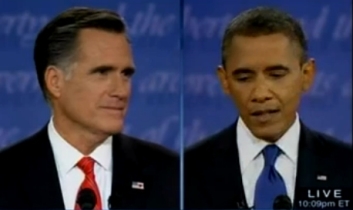 The second was on the role of government generally. “Government is not effective about bringing down the cost of anything,” Romney intoned during the health care segment, adding that “the private market and individual responsibility always work best.” Rather than letting Romney drag him into the weeds on the similarities and differences between Obamacare and Romney’s Massachusetts reform, Obama should have seen this as a golden opportunity to pivot into painting Romney as an anti-government extremist. He should have reminded viewers of the many critical things that only government can do, from public safety and public health to transportation, education and poverty alleviation, and then bridged to threats to these core public functions posed by Romney’s and the Republican party’s approach to government.
Painting Romney as beholden to the far right instincts of his party is a key piece of the president’s re-election campaign strategy in battleground states, yet a disengaged Obama in Denver failed to identify and seize on opportunities to do just that. Some observers after the debate chalked it up to being out of practice, or to running an administration where he is rarely if ever challenged in the way that Romney did on stage. Others said Romney came with a plan and Obama didn’t. All of that could be right, but the biggest impression I came away with was that Obama just wasn’t dialed in.
Shortly before the debate began the networks reported that Mitt Romney came to the hall for the debate after finishing a Cheesecake Factory dinner. I was all ready with my snarky elitist quip about how that kind of culinary decision making surely disqualifies one’s candidacy for Leader of the Free World. Memo to Axelrod: Apparently there’s some secret sauce in that cheesecake.
Funny how news cycles come and go. The far right’s effort over the last couple of days to foist an angry-black-man video of a 2007 Obama speech on us now fades into oblivion, replaced by a 90-minute disengaged-black-president video that has Mitt Romney enjoying the next couple of news cycles a whole lot more than the last several.
A version of this post appears on the Nashville Scene‘s Pith in the Wind blog.
How Romney Reboots the Race
Posted: October 1, 2012 Filed under: Politics Leave a comment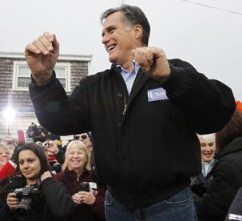 Much of the chatter in the run-up to Wednesday’s first debate is about how Mitt Romney seizes the opportunity to reverse the blue momentum that opinion polls have been documenting over the last few weeks. The obvious answer is lurking deep in the internals of this morning’s new Washington Post/ABC News poll.
Near the bottom of that survey pollsters assess the all-important likability factor, but not in a direct way, like asking respondents how much they like each candidate. Instead, they pose a set of comparative hypotheticals of the “who would you rather do ___ with” sort. Here’s the full set of questions and the overall result for registered voters in the sample who responded to each question:
On a ship in a storm, who would you rather have as the captain? (Obama +12%)
Who would you rather invite to dinner at your home? (Obama +22%)
Who would you rather go on an overnight camping trip with? (Obama +14%)
Who would you rather have babysit your children? (Obama 41%, Romney 41%)
Whose music playlist would you rather listen to? (Obama +16%)
Who would you rather see as a contestant on Dancing with the Stars? (Obama +25%)
On most of these questions demographic breakdowns favor Obama regardless of age, gender, income, or education. Even those over 50 would rather listen to Obama’s playlist by 10 percentage points. Only those who self-identify as Republicans or conservatives are more apt to invite Romney to dinner, go on a camping trip with him, or groove on his tunes.
But how about that babysitting thing? Men prefer Romney as babysitter by 15 percentage points, as do folks who make more than $50K/year. Those with a college degree would rather have Romney looking after the kids by 8 points, while those without prefer Obama by 7 points.
And — to come to the heart of the matter — what about those all-important independents? It turns out they favor Romney by 2 points as babysitter, but prefer Obama by 14 points as dinner guest (and for dinner music prefer Obama’s playlist by 13 points). Bottom line: independents want Romney to keep an eye on the kids while they spend quality time making goo-goo eyes at the incumbent president.
So Romney’s strategy for Wednesday is now abundantly clear. To win the debate and move the needle, forget jobs, forget the taxes, forget the Middle East. Just look voters straight in the eye and make us a poll-tested promise: “Vote for me and I will come over and babysit.” Game change!
By the way, personally I would much rather see Romney dance than Obama.
A version of this post appears on the Nashville Scene‘s Pith in the Wind blog.
Tennessee Headed in a Blue Direction?
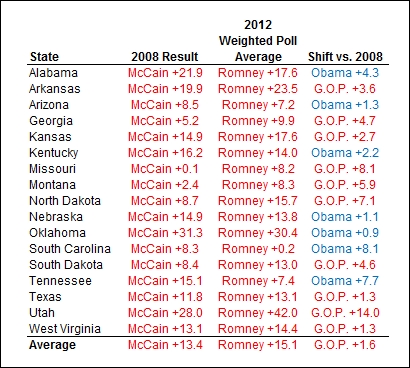
Posted: September 26, 2012 Filed under: Politics Leave a commentIs Tennessee headed toward battleground status? Ok, perhaps not, but we do know from polling that Tennessee voters are less hostile to the Democratic presidential ticket than they were four years ago, and our red-blue gap is shrinking faster than most other deeply red states. At least that’s a plausible conclusion one can draw from data compiled by Nate Silver at the The New York Times‘ FiveThirtyEight blog. Silver compared the final presidential election result in 2008 with a weighted average of current election polling in each of 18 solidly red states:
Source: FiveThirtyEight at The New York Times
In 10 of 18 states the red grows redder — a polling lead for Mitt Romney that exceeds John McCain’s 2008 margin of victory. In the other seven, all still with Romney ahead, the redness has paled — a smaller Romney edge in polling now compared with McCain’s margin four years ago. The two states with the biggest shift blueward are South Carolina followed by Tennessee — the latter showing the red margin of advantage cut in half. And the polling data is pretty good in extent and quality: Silver’s weighted number for Tennessee relies mainly on two surveys: a YouGov poll earlier this month (finding Romney +8 among registered voters) and a Vanderbilt poll in May (Romney +7 among registered voters).
Extrapolating optimistically (if impulsively), Tennessee should be a battleground state by 2016. Not holding breath.
A version of this post appears on the Nashville Scene‘s Pith in the Wind blog.
Chick-fil-A Continues to Dissemble
Posted: September 21, 2012 Filed under: Corporations Leave a comment Maybe Chick-fil-A really does want to turn over a new leaf and rebrand itself as a corporation that doesn’t hate gay people, but if so the company is sure making a feckless hash of it. The purveyors of gay-hate chicken returned to the news earlier this week when a Chicago alderman who had been trying to keep the chain from expanding in his neighborhood announced that Chick-fil-A would now assert publicly its respect for all sexual orientations and would no longer funnel money through its affiliated foundation to groups opposing same-sex marriage. But according to an AP report late Thursday, although the company says its “corporate giving has been mischaracterized,” it still hasn’t made it clear whether its giving approach has actually changed.
So we go to the Chick-fil-A corporate media relations site for the company’s latest press release:
We want to provide some context and clarity around who we are, what we believe and our priorities in relation to corporate giving. A part of our corporate commitment is to be responsible stewards of all that God has entrusted to us. Because of this commitment, Chick-fil-A’s giving heritage is focused on programs that educate youth, strengthen families and enrich marriages, and support communities. We will continue to focus our giving in those areas. Our intent is not to support political or social agendas.
The release links to an accompanying four-page document, Chick-fil-A: Who We Are, that purports to explain the company’s overall policy toward support for social causes and community initiatives. It asserts a commitment to treat “every person with honor, dignity, and respect” regardless of sexual orientation, but on the issues of LGBT rights and marriage equality there is only a restatement of the line in the news release about supporting programs that “help strengthen and enrich marriages.”
There is nothing inherently sinister about a company that wants to “strengthen and enrich marriages” while peddling chicken sandwiches. Chick-fil-A’s problem is that through its donations over the years it has been incorporating vitriolic anti-gay bigotry as a featured condiment. The company’s supporters want us to believe that their pro-marriage agenda is not an anti-gay one. But what are we to think when thousands of dollars end up in the hands of, say, the Eagle Forum, which regards the expansion of LGBT rights as not merely a bit of a bummer, but as a seismic change in “cultural landscape” that could “threaten the very existence of our civilization.”
Telling the public that your corporate goal in this arena is only to support the wonderful institution of marriage while giving money to groups that support the wonderful institution of marriage but also hate gay people with every fiber of their being doesn’t cut it. So forgive us, Chick-fil-A, if we aren’t taking your half-hearted attempt at a corporate PR makeover at your word. You say you want to “remain out of this political and social debate.” Fine, now prove it. Here’s the news release you need to issue:
We regret that in our efforts to strengthen and enrich marriages we have gotten mixed up with groups that traffic in bigotry. We will no longer funnel a dime of corporate money to pro-marriage groups, like Exodus, Eagle Forum, the Family Research Council, the Fellowship of Christian Athletes, who regard being gay is a threat to civilization and who support using public policy to deny equal rights to the LGBT community. We now understand that when you support a group financially, even if your intention is limited to some particular aspect of their agenda, you wear their entire agenda as your own. We say as a corporation that we will treat every person with honor, dignity, and respect regardless of sexual orientation. We are now prepared to live that commitment, not just say it.
That will get you out of the political and social debate, and back in the business of selling chicken — to everyone.
A version of this post appears on the Nashville Scene‘s Pith in the Wind blog.
47gate: The Myth of Progressive Taxes
Posted: September 19, 2012 Filed under: Economics, Politics Leave a commentMuch of the chatter about Mitt Romney’s now infamous half-the-country-can-go-fuck-itself video has focused on that 47 percent who in Romney’s words “are dependent upon government, who believe that they are victims…who pay no income tax.” It was this armchair analysis that inspired Romney to conclude in words that may someday grace the tombstone of his presidential bid: “my job is not to worry about those people.”
In the wake of this latest outbreak of Mittastatic cancer of the campaign voicebox much is being said about who actually comprises that 47 percent, and about Romney’s seemingly fundamental misunderstanding of the nature of tax obligation. This, in turn, predictably elicits the usual whining from the right about how wealthy taxpayers supposedly pay way more than their fair share of taxes.
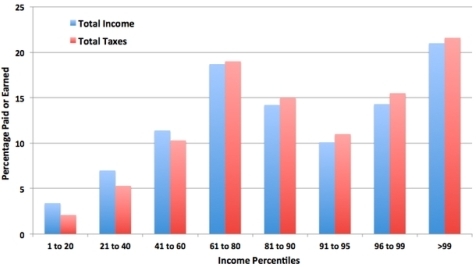
At a time like this it’s worth reminding ourselves that our tax system isn’t really terribly progressive. A good way to judge is to look at the income people in particular brackets earn and compare it with the tax revenue that comes out of those same brackets. If lower income people pay a much smaller proportion of taxes compared to the proportion of income they earn, and if higher income people pay a much larger proportion of aggregate taxes than they earn, then we have a highly progressive system. So what does it actually look like?
The chart below, from The Atlantic based on data compiled by Citizens for Tax Justice, answers the question. Blue bars (income) are a bit bigger than red bars (taxes) at lower incomes, while red bars are slightly bigger than blue bars at higher incomes. In other words, very modest progressivity. Or as The Atlantic‘s economics writer Matthew O’Brien aptly puts it, “If this is Marxism, it’s very carefully disguised.”
Source: The Atlantic
A version of this post appears on the Nashville Scene‘s Pith in the Wind blog.
Ground Game
Posted: September 18, 2012 Filed under: Politics Leave a comment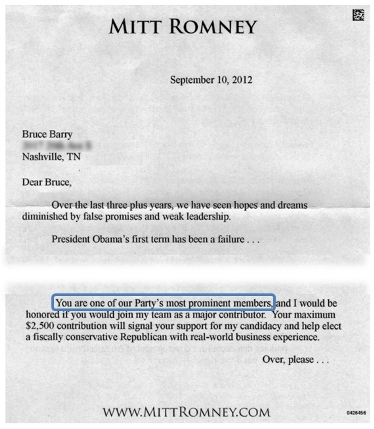 We keep hearing that the presidential election this year may come down to who has the better ground game, and perhaps it will if Mitt Romney can manage to go a week or two without another self-inflicted verbal catastrophe.
But what kind of effective ground game can the Romney campaign possibly be cultivating if they are sending a fund-raising letter to someone like me?
Public election records that campaigns mine to target contributors and voters show that I’ve been registered in the same county for over 20 years, vote in essentially every election, and have never voted in a Republican contest in our open primary system.
Granted, I’m just one schmoe in a state that doesn’t matter at all strategically. But if the Romney folks are dropping mail pieces on people like me, then supporters who actually give money to his campaign should be seriously concerned about how their dollars are being spent.
Defining the Middle Class
Posted: September 14, 2012 Filed under: Economics, Politics Leave a comment Arguments over what politicians mean when they say they want to help the “middle class” are almost as old as the existence of a middle class. And with both Mitt Romney and Barack Obama beating the middle class drum silly this political season, it was only a matter of time before a conversation about who is and isn’t in the middle class resurfaced.
And so it did with Mitt Romney’s exchange with George Stephanopolous on ABC Friday morning:
MITT ROMNEY: Let me tell you, George, the fundamentals of my tax policy are these. Number one, reduce tax burdens on middle-income people. So no one can say my plan is going to raise taxes on middle-income people, because principle number one is keep the burden down on middle-income taxpayers.
GEORGE STEPHANOPOULOS: Is $100,000 middle income?
MITT ROMNEY: No, middle income is $200,000 to $250,000 and less.
As the Wall Street Journal‘s What Percent Are You calculator reveals, $200K puts you in the 94th percentile of tax-filing households, and $250K puts you in the 96th percentile. So to the extent that Romney believes that being middle class in 21st century America means being in the top 4-6 percent, he’s going to deserve the ridicule he has manage once again to self-inflict. Of course, Romney did say $200-250K “or less,” so presumably he doesn’t put the middle class household wage floor at $200K. Even he’s not that dim.
To be fair, some will point out that Barack Obama’s pledge to avoid raising taxes on the middle class, coupled with policy proposals that preserve tax cuts for those earning less than $250K, means that Obama also defines the middle class all the way up into the mid 200Ks. I’m not aware that Obama has been clumsy enough to make that upper bound explicit as a definitional matter in the way that Romney just did. And of course, any definition of middle class tied to raw income levels or earning percentiles is flawed by its failure to factor in vast geographic differences in cost of living, not to mention variations in household size and other relevant factors. As we all know, a given level of income goes a whole lot further for a childless couple in Nashville than for a family of four in San Francisco.
So where should we locate the middle class in household income terms? A recent Wall Street Journal Marketwatch piece blandly asserted that the middle class is comprised of “the 50% of American households earning between $39,000 to $118,000.” Using the Journal‘s calculator, that range runs from the 46th to the 84th percentile of tax filing households … and seems rather arbitrary.
We know from recent Pew survey data how many self-regard as middle class: Just under half of adults call themselves middle class, only a few percent less than said the same thing four years ago, with reasonably similar percentages saying this across gender and race divides.
If being middle class is essentially a state of mind, then one way to define a middle class income is to ask people where they would peg the number. The Pew survey gave that a shot, asking respondents to say how much annual income a family of four would need to lead a middle-class lifestyle. The overall median response to this question was $70K – a number not far off from the actual median income for a four-person household based on Census Bureau numbers ($68.2K) and well below the definition of middle class amidst the rarified air on Planet Mitt.
An alternative approach is to think about the key elements of consumption one’s income makes possible, or easy, or not so easy. I kind of like the version of this approach put forward by some guy named Eric commenting on a blog post about the Romney remark at The Atlantic:
You should define class by the ability to pay for two new cars, a $1200 mortgage (arbitrary for this comment), private schools (especially if you live in a city), a $3,000 health insurance deductible, and organic/sustainably produced foods. Then assume that most people pay for cable and cell service. Anyone who doesn’t worry about these things is above middle class. Anyone who must make trade-offs among them is in the middle. Anyone who cannot pay for any of these is poor.
We can quarrel about the organic food part, but otherwise it makes quite a bit of sense to me.
A version of this post appears on the Nashville Scene‘s Pith in the Wind blog.


 BruceBarry.net