
Pre-Election Freakout Prophylaxis
Posted: October 29, 2012 Filed under: Politics Leave a commentMittmentum getting you down? Worried sick that the election is slipping away? Stockpiling water and batteries for the coming apocalypse one might affectionately label a “Romney-Ryan administration”? I have the remedy, and it comes from those dastardly polls.
The campaign endgame began with the conclusion of the final presidential debate last Tuesday, and since then both sides have felt compelled to frame a piece of their closing argument as “we’re winning” — partly as a GOTV turnout strategy and partly as media narrative management strategy. With so many polls now released daily it is somewhat possible for each side to cherry-pick some data to build an impending victory spin.
But get a grip, Obamaphiles: The fact is polls in the aggregate are actually painting a quite consistent picture, one that favors Obama in almost all the important battlegrounds. The picture looks like this: In every key state starting in mid-August (pre-conventions), Obama built a lead, a working margin that was whittled down in the wake of the first debate on Oct. 3 to a substantially smaller lead. And here’s the essential part: Since the few days immediately following that first debate (roughly the period Oct. 4-9), the race has been stable … a smaller but consistent Obama lead, with the raw numbers for Obama and for Romney creeping up in tandem as undecideds break.
You can see this dynamic in every state that matters: Ohio, Iowa, Wisconsin, Colorado, Virginia, New Hampshire.
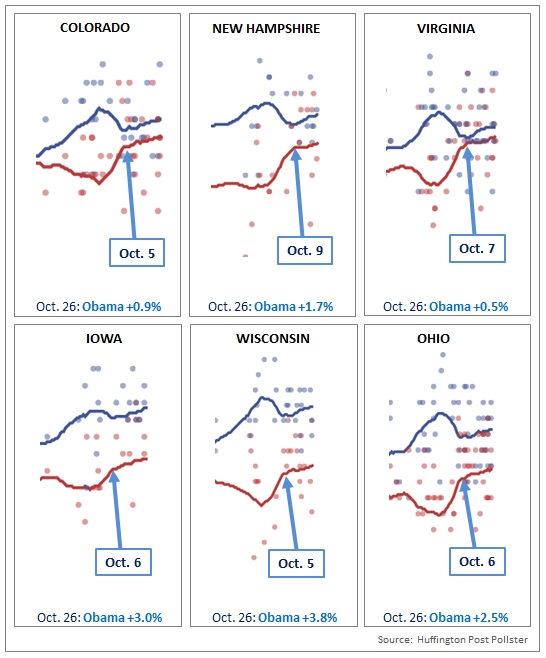
In this chart I have grabbed a piece of the Huffington Post Pollster battleground state poll aggregations for each of these six states. Each state’s chart begins at Aug. 20 and ends at Oct. 26.
See the pattern? Kind of unmistakable. Debate #1 gave Romney back most of the terrain he lost during his bad post-convention stretch, but it gave it back to him quickly, and the race in these battlegrounds has been pretty stable ever since. Yes, the national polls took longer to settle down and they currently show a popular vote race that is excruciatingly close — essentially tied and perhaps even a slight Romney lead.
But it is also the case that Romney has not broken through in battleground states in a way that turns the Electoral College math in his favor. He still has a week to pull that off, and it’s hard to see how he manages it. (This may explain why Romney felt the need late last week to try to scare the bejesus out of Ohio voters by making shit up out of whole cloth about jobs moving to China.) So keep those freakout dials set low, Dems.
Methodological note: The Huffpost Pollster aggregation method, explained here and here, doesn’t merely average polls; it takes into account variations in sample sizes (giving more weight to better samples) as well as pollster house effects. By the way you see this same pattern in red-leaning battleground states (North Carolina and Florida) — a bump for Romney in the week following the first debate, and essentially a stable race since then.
A version of this post appears on the Nashville Scene‘s Pith in the Wind blog.
CEOs to GOP: That Pig Won’t Fly
Posted: October 25, 2012 Filed under: Corporations, Economics Leave a comment John Ingram, the CEO of La Vergne-based media conglomerate Ingram Content Group, is among a list of more than 80 chief executives of major U.S. firms pressuring Congress to address the nation’s fiscal problems with both tax increases and spending cuts. The CEOs’ joint letter summarizes their approach in three bullet points:
The plan should:
Reform Medicare and Medicaid, improve efficiency in the overall health care system and limit future cost growth;
Strengthen Social Security, so that it is solvent and will be there for future beneficiaries; and
Include comprehensive and pro-growth tax reform, which broadens the base, lowers rates, raises revenues and reduces the deficit.
By pointing to the bipartisan Simpson-Bowles Commission as “an effective framework for such a plan,” the CEOs will make some Democrats unhappy given how far Simpson-Bowles goes in advocating potential cuts to cherished programs. And they will surely make many Republicans unhappy by admitting the obvious: that raising revenue is also essential.
As The Wall Street Journal reports, this approach is a noticeable departure from other business groups, which tend to sidestep the matter of raising taxes. Although the CEOs aren’t explicitly aiming the message in any particular political direction, what we have here is an impressive list of top executives from a variety of companies telling Mitt Romney and the Republican party that their approach to debt and deficit reduction eschewing any possibility of new revenue simply isn’t credible.
The CEO statement comes from and through the Campaign to Fix the Debt, a self-proclaimed non-partisan movement to “mobilize key communities — including leaders from business, government, and policy — and people all across America who want to see elected officials step up to solve our nation’s fiscal challenges.” The Campaign’s founders are Alan Simpson and Erskine Bowles (yes, that Simpson and that Bowles). Former Tennessee Gov. Phil Bredesen is a member of its steering committee.
A version of this post appears on the Nashville Scene‘s Pith in the Wind blog.
Debate Round 4: Horses, Bayonets, and Cheap Chinese Tires
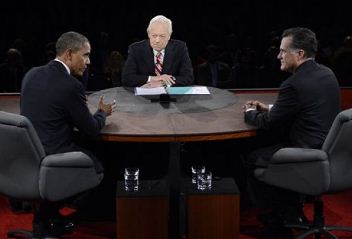
Posted: October 23, 2012 Filed under: Politics Leave a comment The third and final presidential debate followed the same format as the first: six 15-minute segments each marked by and launched with a new question from the moderator. Unlike the meandering festival of time drift presided over by Jim Lehrer two weeks ago, Bob Schieffer ran this one with well-oiled precision, starting each segment right on time and quietly herding the candidates into exchanges that yielded roughly equal time. Schieffer’s followup questions were few but useful, and you never had the feeling that he had lost control or left the building. Clear win for the moderator.
And how did the other two guys do? In the spirit of the debate’s hexagonal structure, I’ll recap with snap (and perhaps occasionally snappy) judgments of each of the 15-minute block segments.
8:00 pm (pregame): Wolf Blitzer at CNN, just before throwing it over to the debate hall, sets the mood by telling viewers that “one misstatement could cause international ramifications.” Way to raise false hopes, WB. If no international incident comes out of this we’re going to be very disappointed.
8:00-8:15. First up was Libya, and with his first tepid answer it was quickly apparent that Mitt Romney came to play it safe, avoid conflict, show off memorized factoids (he mentioned Mali twice in the first ten minutes, for crying out loud), and generally focus on the “appear presidential” thing. Obama made it just as quickly obvious that he wasn’t playing the same game, telling Romney that “every time you’ve offered an opinion you’ve been wrong.” Romney shot back that “attacking me is not an agenda,” which quickly trended bigtime in the right wing Twittersphere, even if attacking him actually is a quite effective agenda, in a debate anyway. Obama wrapped up the segment lecturing Romney to “listen up, punk” (“Here’s one thing I’ve learned as Commander in Chief” was the exact phrase) on the need to be clear to allies and foes “about where you stand and what you mean.” Romney’s face: not happy. Advantage Obama.
8:15-8:30. Second segment was on Syria, and here we started to see just how prepared Romney was to reinvent himself on foreign policy to make his approach look more or less exactly like Obama’s. Obama tried to slam Romney with the charge that “he doesn’t have different ideas,” but it comes off inevitably as a pretty benign critique when the worst thing you can say about your opponent is that he agrees with you. Obama is vulnerable on Syria, given how hard it is to defend a pretty minimalist policy in the face of atrocity, although Romney didn’t capitalize. For the segment, slight advantage Romney despite some rambling, if only because he seemed able to articulate Obama’s position on Syria at least as well as Obama did.
8:30-8:45. This was the domestic issues part of the foreign policy debate, disguised as a question about America’s role in the world. It turns out America’s role in the world is to argue about its own unemployment rate and energy policy. Obama landed punches connecting Romney’s “wrong and reckless policies” at home and abroad directly to George W. Bush and Dick Cheney. Romney responded with his economic stump speech (five-point plan, 12 million jobs, etc.), and somehow the exchange devolved into an exchange on education policy in Massachusetts. Granted, many Romney supporters do see things that happen in Massachusetts as foreign policy, but it still felt like we had strayed just a wee bit. Schieffer pulled the train back on the track with a followup asking Romney where he’ll find the money for more military spending. This led Romney into his “smallest Navy since 1917” schtick, onto which Obama pounced with his observation that Romney needs to learn more about changing times because “we also have fewer horses and bayonets.” Did you have “bayonets” on your debate drinking game list? I know I did. Advantage Obama for articulating a position on military spending grounded in strategy rather than red-meat blusterc.
 8:45-9:00. With a question on Iran this was the who-can-stroke-Israel’s-penis-with-greater-devotion-and-tenderness part of the evening. Romney again spent more time agreeing with Obama than differing, saying of the sanctions imposed on Iran that “they do work…You’re seeing it right now in the economy.” It turned nastier when Romney played one of his moldiest oldies — the “Obama apology tour” card, which the CNN dial group did not go for at all, and which Obama dismissed as “just about the biggest whopper” of the campaign. Romney offered up the painfully simplistic but rhetorically effective observation that “We’re four years closer to a nuclear Iran” coupled with a scolding of Obama for skipping Israel on that 2008 “apology tour” (drink); Obama comes back at him with a narrative travelogue of his visit to Israel in 2008 as a candidate. Romney asserts our influence around the world is receding “because of the failure of the president to deal with our economic challenges at home” (pivot!). Obama thanks Romney for supporting his policies, and wraps up the segment with an emotional ground zero story. A draw on Iran and Israel (both quite tender and devoted); slight advantage Obama for leaving Romney with a look on his face that says “now where did I put that bayonet?”
9:00-9:15. Afghanistan. There is very little daylight between their approaches here, and it showed. Both plan to be out by the end of 2014, both think Pakistan is a scary place, both like drones and killing bad guys. The exchange does show that on at least this one issue U.S. policy is basically unified and bipartisan. That might be a good thing, except that as a result nobody is having a serious moral conversation about the use of drones for indiscriminate killing of innocent civilians, about presidential kill lists, about the limits of executive power in the age of terror. Advantage: mindless violence and endless war.
9:15-9:30. China! If you had “cheap chinese tires” on your drinking game list this was the segment for you. Obama accuses Romney of poor judgment on trade involving said tires, then pivots back to domestic issues — education, technology, and the evils of Romney’s budget. Romney replies that the greatest threat the world faces is nuclear Iran (just to make sure we all get that), and then launches his China currency manipulation bit, which always kills. Schieffer asks if Romney is planning to start a trade war, Romney reveals his recent discovery that there are counterfeit products out there (valves of some sort), and before you know it Obama is telling us that if we listen to Romney “we’d be buying cars from China instead of selling cars to China.” Obama neglects to say if those cars would have cheap Chinese tires on them. (drink anyway!) The China-trade segment is more or less a draw until Romney lets Obama bait him on the auto bailout into a defensive rant (an attempt to “airbrush history,” Obama declares). Cue an Obama stump speechlet on domestic policy, followed by a Romney stumplet, culminating in a gratuitious assertion that “I love teachers.” You mean like you love Israel?
9:30ish. Closing statements. Both candidates hop another fast train to boilerplate city. Nothing compelling although Romney did assert that he wants “to see growing peace in this country.” I have no idea what that means but candidates don’t talk about peace enough in my book, so slight advantage Romney on the closing statements.
Who won? The instant polls said Obama, ranging from margins of 8 points in CNN’s survey of debate watchers to a whopping 30 points in a CBS poll of only undecided voters. And as well they should: We can concede that Romney accomplished his modest goal of looking reasonable and qualified, and we can debate whether the all important wilted-flower voting segment finds verbal assertiveness off-putting. But the bottom line is that we saw the incumbent deliver an adept, knowledgeable, forceful performance that generally over-matched the well meaning foreign policy amateur sitting next to him. It won’t move the polls as debate #1 did, but it does amply reinforce the current narrative: a very thin Obama lead nationally, with a bit of a wider margin in the electoral college — leads that are barely there, but more likely to expand (though not much) than contract.
But wait …
10:48 pm: Hannity on Fox points out that horses are ridden by soldiers in Afghanistan. Anderson Cooper on CNN mentions that Marines still use bayonets. Obama gaffe city, baby! Cue the 24/7 cable spin cycle! Game, set match! Call the election! It’s over!
A version of this post appears on the Nashville Scene‘s Pith in the Wind blog.
Debate Round 3: Sketchy Deals and Womanly Binders
Posted: October 17, 2012 Filed under: Politics Leave a comment First sign that a debate didn’t go very well for your side: when the gathering conventional wisdom on your side is that the outcome is a draw. That’s where the sensible GOP money seemed to land as the dust settled after Tuesday night’s second presidential debate at Hofstra University on Long Island. Sure, there were the inevitable true believers, like Red State blogger Erick Erickson, who somehow managed to convince himself that Mitt Romney ate Barack Obama’s lunch. But cooler redheads sought to detoxify Romney’s underwhelming performance with an antidote of balance. The National Review’s Ramesh Ponnuru credits Obama with halting liberal handwringing but concludes “otherwise a draw.” Former Bush flack Ari Fleischer merged Romney’s jabs at Obama’s first-term shortcomings with Obama’s assault on Romney into the same conclusion: “draw.” Anyone buying that?
Second sign that a debate didn’t go very well for your side: when your dominant post-debate spin theme is an obsessive attempt to read earth-shaking subterfuge into an unremarkable short phrase in a presidential statement on a narrow issue that very few people care about. The subject here, of course, is Libya, and it was one of the most heated exchanges of the evening. Taking umbrage at Romney’s suggestion that he wasn’t on the ball right after the 9/11 attack in Benghazi, Obama pointed out that he stood in the Rose Garden the next day and said it was an act of terror. Romney, effectively calling the president a liar, insisted that “it took the president 14 days before he called the attack in Benghazi an act of terror.” Obama shot back, “Get the transcript.” What that transcript shows is Obama saying on 9/12: “No acts of terror will ever shake the resolve of this great nation.” The meaning here and its connection to the Benghazi raid is patently obvious, yet many Repubs were beside themselves after the debate denying this clear semantic reality (for instance, a Karl Rove tweet: “Obama didn’t directly call Lybia attack ‘act of terror’ in Rose Garden — broadly referred to acts of terror”). This is not to say that the Obama administration might not still have a bit of a Libya problem. It is to say that if you’re building your post-debate spin on a dubious parsing of words in a month-old statement, it didn’t go very well for your side.
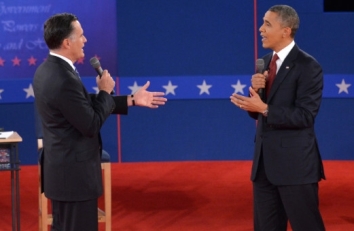 Third sign that a debate didn’t go very well: when you start piling on the moderator. Some Dems fell into this trap after the disaster in Denver twelve days earlier, and this time it’s Republicans calling CNN’s Candy Crowley to account for letting Obama talk too much or for picking biased questions, or (especially) for injecting her own factual take. Her crime: saying to Romney in an attempt to move the Libya conversation off the did-so-did-not stalemate: “He did call it an act of terror.” For this mild act of honest journalism, wrote Jim Geraghty at the National Review, “Candy Crowley is responsible for one of the most egregious misjudgments of any moderator in the history of presidential debates.” Holy overreaction, Batman!
Romney wasn’t uniformly terrible by any means. He offered the usual, and as usual pretty effective, critiques of Obama’s record on domestic economic matters, overachieved on a question inviting him to distinguish himself on policy fronts from George W. Bush, and displayed at times his customary deftness at pivoting from issues raised to Obama jabs.
 But just as Obama in Denver seemed unprepared to cope with revisionist Mitt, Romney at Hofstra came off as blindsided by the directness of Obama’s punch after punch at Romney’s policies as well as his shifting inconsistencies. On the latter — hammering Romney for running in the campaign’s final weeks on a version of himself that deviates broadly from his more severely conservative past in the primaries — Obama’s frontal assault brought to fruition a major tactical shift. Team Obama has throughout this campaign avoided an emphasis on the flip-flopper angle, having judged that being a flip-flopper isn’t so bad in the eyes of swing voters, especially if the flopping is in a direction those voters like. In deciding how to update Obama’s debate approach after the Denver calamity, Obama and handlers apparently arrived at the sensible decision to spend much more time not just refuting Romney’s arguments, but also labeling them and labeling him. This was effective because there’s not much for the other guy to do in response to a label but deny it — and appear defensive in the process.
Certainly Obama benefited substantially from some of the territory covered. Given the corners into which Romney allowed himself to be painted by his party’s primary process on social issues, there is no imaginable debate context in which Romney is likely to come off well on subjects like pay equality, contraception, and immigration. Plus Obama made some adroit preemptive moves. For instance, instead of waiting for Romney to bring up something like Planned Parenthood and use it as a cudgel, Obama went there first, waving PP (appropriately) as a badge of honor in his defense of women’s health issues, then offering it up again later to make the point that Romney on social issues is to the right of George W. Bush. Although lots of spinners tweeted lots of platitudes afterward, I do think veteran Dem Donna Brazile aptly summed up the effectiveness of Obama’s attacks: he “knew Romney’s positions better than his opponent.”
Fourth sign the debate isn’t going well: when you find yourself telling the other guy he should spend more time with his mutual fund statements. Perhaps Romney will be kind enough to lend Obama some binders to store them in.
A version of this post appears on the Nashville Scene‘s Pith in the Wind blog.
Debate Round 2: As My Guitar Gently Veeps
Posted: October 12, 2012 Filed under: Politics Leave a comment The definition of a draw in a vice presidential debate has three elements: (1) each side can say with a reasonably straight face that its guy did well and prevailed; (2) each side can say with similar face that the other side’s guy was, well, faced; and (3) both sides can make these claims publicly without coming off as delusional or hallucinatory. All three conditions were met at Thursday’s debate, and a pair of instant polls right after piled on with a mixed verdict: a CBS survey of uncommitted voters gave Joe Biden the wind by 19 points (50-31), while a CNN survey had Paul Ryan up by 4 points (48-44). Taken as a whole it adds up to a night where everyone finds a reason to come away happy and nobody goes to bed grumpy, as huge swaths of blue America did last week.
There was good and bad in each candidate’s performance. Biden was frequently assertive and substantive — when he wasn’t being snide and dismissive. On the down side, he had trouble at times stopping himself from being overly snide and dismissive. Yes, several of Ryan’s vapid little prepared speechlet-answers invited dismissiveness in spades, but the act of being dismissive eats valuable time that could have been used to cry bullshit in a far more substantive ways.
Much will be said about Biden’s occasional high-amp grinning and eye-rolling while listening to Ryan speak. Ok, we get it, the debate coaches wanted upbeat and engaged, not dour like Obama last week, but this was overcompensating. It seriously overstates the case to call it, as Fox News’s Brit Hume did, “derisive sneering,” but it did grow off-putting. Fortunately, as the debate wore on Biden managed to dial back the split-screen mugging. Early on Biden seemed to have difficulty finding his way into the right give-and-take rhythm with opponent and moderator, but he found his footing in the second half, spending more time orchestrating the conversation rather than just reacting to it. He also knew how to look straight into the camera at times and address the folks at home directly — this worked well. It wasn’t clear that Ryan had any idea where the camera was.
Ryan did show himself to be the prepared and fluent policy guy one expects him to be, full of factoids, having memorized the names and dates and numbers he needed to memorize, as well as the phrases he needed to summon forth to tie his factoids together. He was simultaneously garrulous and glib, if such a thing is possible, spinning a multilayered web of articulate and at times quite persuasive prattle that succeeded in making it hard for Biden to know what to attack first. When this debating style worked, as it did during much of the first half of the encounter, an exasperated Biden would offer up some vague observation about how much of what the audience just heard is nonsense, and the making of that general assertion would crowd out any specific refutation. Point for Ryan. But in the second half Ryan was less effective as Biden seemed to figure out that you combat arguments with better arguments, not with chuckling assertions that the other guy’s arguments are lousy.
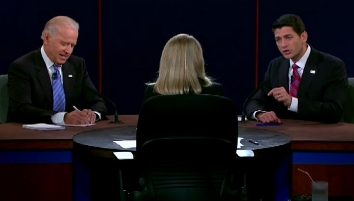 When it comes to the all important pivot maneuver — shifting on a dime from a question posed to an angle preferred —the candidates were both putting on a clinic. Biden did it right out of the gate in the first minute, turning a question about the Libyan embassy debacle into a broad-form treatise on Iraq, Afghanistan, and Osama. Ryan showed he’s got the moves when he turned a mini-lecture on the ticket’s economic plan into a sermon on Mitt Romney as the greatest most magnanimous human who ever walked the planet. Thank God (pun intended) they both turned the moderator’s inane late question about religion into an abortion policy question. My favorite pivot of all was about 56 minutes in when Biden pivoted from debating Ryan to debating the moderator Martha Raddatz. Raddatz was good but Biden won on points.
If Ryan’s objectives were to pass himself off as something other than a scary conservative extremist, and to present himself as someone ready to step into the top job should circumstances require, he’s batting .500. He came off as genial and thoughtful, without rancor, but also as scripted and out of his depth on international affairs. If Biden’s objectives were to reinvigorate a base that was starting to panic after last week, and to arrest the ascent of perceptions that Mitt Romney might be a reasonable, moderate guy after all, he’s one for two as well. Biden’s performance successfully cauterizes the bloodletting about Denver, and should help the already stalling Romney polling bounce to a soft landing. The race returns more or less to where it was a month ago.
When the debate ended, as commentators were busy forging the conventional wisdom — good night for Biden, good night for Ryan, mostly functional moderator, an engaging and substantive exchange — the question on everyone’s mind was “what about those independents?” At 9:30 pm CT were undecideds thinking “Biden sold me”? Were they thinking “that Ryan kid’s got moxie”? Either is possible, but I’m guessing most of them were thinking “holy shit, the Titans are beating the Steelers.”
On to Long Island…
A version of this post appears on the Nashville Scene‘s Pith in the Wind blog.
Vote for Romney … Or You’re Fired!
Posted: October 10, 2012 Filed under: Disgust, Economics Leave a comment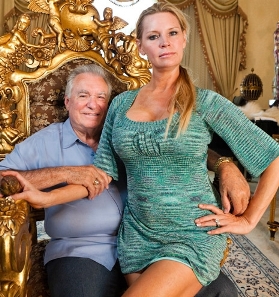 The Queen of Versailles is a grimly hilarious (or hilariously grim) documentary about timeshare magnate David Siegel and spousal unit Jackie, and their ill-fated effort to build the biggest house in America, a 90,000-square-foot monstrosity inspired by, yes, Versailles. Good flick. David Siegel is back in the news this week with an email to his hordes of employees telling them that they can expect to be canned if Barack Obama is re-elected. Excerpts from Siegel’s missive:
There is no question that the economy has changed for the worse and we have not seen any improvement over the past four years. In spite of all of the challenges we have faced, the good news is this: The economy doesn’t currently pose a threat to your job. What does threaten your job however, is another 4 years of the same Presidential administration….
Unfortunately, the costs of running a business have gotten out of control, and let me tell you why: We are being taxed to death and the government thinks we don’t pay enough. We pay state taxes, federal taxes, property taxes, sales and use taxes, payroll taxes, workers compensation taxes and unemployment taxes. I even have to hire an entire department to manage all these taxes. The question I have is this: Who is really stimulating the economy? Is it the Government that wants to take money from those who have earned it and give it to those who have not, or is it people like me who built a company out of his garage and directly employs over 7000 people and hosts over 3 million people per year with a great vacation?….
If any new taxes are levied on me, or my company, as our current President plans, I will have no choice but to reduce the size of this company. Rather than grow this company I will be forced to cut back. This means fewer jobs, less benefits and certainly less opportunity for everyone. So, when you make your decision to vote, ask yourself, which candidate understands the economics of business ownership and who doesn’t? Whose policies will endanger your job?
Read the entire email here. Siegel has every right to tell his employees whatever he wants about his political views or his sex life or his bowel movements. Hey, it’s a free country … especially when you own the email system.
But this notion that Barack Obama, a middle-of-the-road neo-liberal who sucks with vigor at the campaign finance teat of Wall Street and venture capital, and who wants to cut business taxes just like the Mittster, is some sort of enemy of the profiteering capitalist class is simply delusional. Yes, Mr. Siegel, Obama would, given his policy druthers, raise your marginal tax rate by a few percentage points. America’s heart bleeds for the devastating hardships this will bestow upon you and your empire.
A version of this post appears on the Nashville Scene‘s Pith in the Wind blog.
Compelled Speech at Work II
Posted: October 8, 2012 Filed under: Corporations, Free Speech Leave a comment The Murray Energy company made news back in August when some of the coal miners in its employ went public with statements that they were pressured by the company to attend a Mitt Romney campaign event on Aug. 14 at the firm’s Century Mine in Beallsville, Ohio.
Murray Energy returned to the public stage in its role as a leading proponent of compelled workplace speech with this piece at The New Republic late last week describing the firm’s extensive and continuing efforts to channel employee time and money to Republican candidates:
Since 2007, employees of Murray Energy and its subsidiaries, along with their families and the Murray PAC, have contributed over $1.4 million to Republican candidates for federal office. Murray’s fund-raisers have feted the likes of Scott Brown, Rand Paul, David Vitter, Carly Fiorina, and Jim DeMint. Home-state pols get love, too. Murray’s PAC and staffers are the sixth-largest source for Ohio senatorial hopeful Josh Mandel. They’ve given $720,000 to candidates for state office in the past decade.
We all know that federal law requires that firms treat employee participation in company PACs as strictly voluntary, but Alec MacGillis’s TNR investigative piece surfaces plenty of evidence suggesting that things work just a wee bit differently at Murray:
The accounts of two sources who have worked in managerial positions at the firm, and a review of letters and memos to Murray employees, suggest that coercion may also explain Murray staffers’ financial support for Romney. Murray, it turns out, has for years pressured salaried employees to give to the Murray Energy political action committee (PAC) and to Republican candidates chosen by the company. Internal documents show that company officials track who is and is not giving. The sources say that those who do not give are at risk of being demoted or missing out on bonuses, claims Murray denies.
MacGillis goes on to report that the inappropriate pressure on workers can be traced right to the top — to company founder, CEO, and board chairman Bob Murray:
Internal Murray documents show just how upset Murray becomes when employees fail to join the giving. In missives, he cajoles employees to attend fund-raisers and scolds them when they or their subordinates do not. In cases of low participation, reminders from his lieutenants have included tables or spreadsheets showing how each of the eleven Murray subsidiaries was performing. And at least one note came with a list of names of employees who had not yet given. “What is so difficult about asking a well-paid, salaried employee to give us three hours of his/her time every two months?” Murray writes in a March 2012 letter. “We have been insulted by every salaried employee who does not support our efforts.” He concludes: “I do not recall ever seeing the attached list of employees…at one of our fund-raisers.”
Corporate pressure on employees to take part in compelled political speech is nothing new, and clearly the so-called “voluntary” nature of PAC contributions inside firms is experienced by many as something other than voluntary. A survey of finance executives in 2004 by CFO Magazine found 24 percent of respondents saying that not giving to their corporate PAC could be detrimental to their careers, and another 16 percent saying they were unsure. At Murray Energy, compelled speech is apparently a corporate way of life, corralling management and rank-and-file employees alike.


 BruceBarry.net