
Response and Responsiblity
Posted: July 26, 2012 Filed under: Politics Leave a comment Ongoing questions about Mitt Romney’s role in the doings at Bain Capital have been fodder for the Obama campaign’s efforts to paint Romney as an objectionable sort of capitalist who used the mantle of private equity investment to ruin lives and ship jobs overseas. The Romney response has been to celebrate cases where Bain turned around firms without killing them, and to use the calendar (“he had left Bain by then”) as a way to distance the candidate from the less savory cases. Meanwhile, some good investigative reporting has explored the what and when of Romney’s involvement in Bain deals and outcomes.
There are genuine moral questions here about the nature of accountability and responsibility for one’s actions and for the actions of others. When does nominal responsibility become ethical responsibility? Are we morally accountability for things that we put in motion but then step away from? These questions create a striking but so far untapped opportunity for the Obama campaign.
Romney eschews responsibility for things that happened at Bain once he ceased to be actively managing the enterprise. He was listed in dozens of SEC filings as “sole shareholder, sole director, president and chief executive officer” of Bain funds involved in corporate investments and takeovers after he left Bain in 1999 to head the Salt Lake City Olympics.
Avik Roy, a Romney policy advisor who used to work at Bain subsidiary Brookside Capital (a hedge fund), weighed in yesterday at National Review Online:
Which of Bain Capital’s investments is it fair to hold Mitt Romney accountable for? The answer: He is accountable for the investments in which he actually made the decisions. If I have my 401(k) invested in the Fidelity Select Health Care Fund, am I responsible for every decision made by the portfolio manager at Fidelity? Obviously not. The same goes for Mitt Romney.
Journalist David Corn, who has been doing quite a bit of recent investigative reporting on Romney and Bain for Mother Jones, replies to Roy:
This was hardly equivalent to a retirement fund investment. Romney “wholly owned” Brookside, according to a SEC filing. He created this entity. No doubt, he had a say regarding who was managing it. It was part of the Bain world he oversaw. He bears a degree of responsibility—perhaps Romney can calculate the precise percentage—for this venture.
Corn is right that Roy’s retirement fund analogy is silly; there’s a world of difference in proximity to decision making between being one of thousands of mutual fund shareholders and being the sole director and CEO of an investment entity that you yourself helped to create. You get the feeling that Roy himself realizes this, given that he devotes ten paragraphs following the analogy to a defense of the moral legitimacy of the investments for which Romney is supposedly not accountable.
The surprising thing politically is that Team Obama is focused narrowly on trying to make this into a wonky campaign argument about Romney’s role in layoffs and outsourcing, along the lines of “look at the economic pain that resulted from Bain investments that occurred when Romney was signing documents as sole shareholder and CEO even though he says he had moved on.” That’s a lovely but overly complicated narrative. Instead of hitting Romney for irresponsible capitalism, Obama should be hitting Romney for irresponsibility, period. Forget about trying to slice and dice the specifics of what result this or that Bain investment in the early 2000s yielded for this or that factory in the midwest.
Having successfully (some might say masterfully) goaded Romney into splitting these legal hairs on the meaning of his signature on SEC filings, the message should be a straightforward assault on Romney’s character, along the lines of: Mitt Romney doesn’t believe in taking responsibility for his actions. He signs off as chief executive and then says he had nothing to do with it. This responsibility claim should also encompass the numerous instances in which Romney has changed positions over the years on various issues: He doesn’t believe in taking responsibility for his words.
Democrats are accomplished at complaining that Republicans have the upper hand when it comes to messaging that frames an attack in simple, direct terms that everyone can grasp and then repeats it endlessly. Socialism. Taxing job creators. Death panels.
With his signature on dozens of SEC documents, Romney has handed Democrats just such a messaging opportunity. A lack-of-responsibility narrative that marries the Bain experience with Romney’s many changes of position gives Dems a chance to do unto Repubs as they have done unto Dems. And it can be done with integrity — there is nothing in such a strategy that distorts or stretches the truth, or removes it from context.
A version of this post appears on the Nashville Scene‘s Pith in the Wind blog.
“You Didn’t Build That”: The Conversation We Aren’t Having
Posted: July 20, 2012 Filed under: Corporations, Politics 5 Comments It’s been a week since President Obama in a speech in Roanoke, Virginia offered up his “you didn’t build that” observation about business success, and Team Romney is still trying to make hay out of it. As recently as yesterday Romney declared in a stop-by at a local business in Massachusetts that “The president does, in fact, believe that people who build enterprises like this really aren’t responsible for it.”
It’s hardly surprising that a campaign trying desperately to shift from a defensive posture on matters of private equity and tax returns would seize on anything to change the subject, and perhaps that explains how this particular tidbit of second-rate campaign discourse distortion has kept its legs for a full week — an eternity in the news cycle game. (There’s nothing like yet another gun rampage mass shooting to really change the subject.)
But while Romney may have twisted Obama’s remarks last Friday into something never said or intended, the Mittster does edge dangerous close to having a point when he says of Obama, as he did yesterday, “It wasn’t a gaffe. It was instead his ideology.” The conceptual relationship between capitalism and infrastructure is actually a crucial and fascinating subject, one that does define significant differences between the candidates and their parties — or one that might if there could be a serious conversation about it instead of just harping on out-of-context utterances.
First let’s be clear about the distortion involved. This is what Obama said in Roanoke last Friday on this subject, from start to finish with no omitted words:
“If you were successful, somebody along the line gave you some help. There was a great teacher somewhere in your life. Somebody helped to create this unbelievable American system that we have that allows you to thrive. Somebody invested in roads and bridges. If you’ve got a business you didn’t build that. Somebody else made that happen. The internet didn’t get invented on its own; government research created the internet, so then all the companies could make money off the internet. The point is that when we succeed, we succeed because of our individual initiative but also because we do things together. There are some things, like fighting fires, that we don’t do on our own.”
And this is how Mitt Romney recounted Obama’s remarks:
“He said, ‘If you’ve got a business, you didn’t build that. Somebody else made that happen.'”
It does seem rather obvious that “you didn’t build that” refers to what came in the sentence before — infrastructure such as roads and bridges. Yes, one could make a grammatical argument, as James Taranto at the Wall Street Journal did, that “roads and bridges” is plural, while “that” is singular, so the word “that” should properly be “those” if Obama meant to say that successful entrepreneurs didn’t build roads and bridges. Point of grammar taken. But on that small fault in syntax we should believe that Obama meant to say something different that the otherwise extremely clear meaning of the entire passage? Really?
But campaign out-of-contextery aside, it is more than legitimate to ponder the extent to which business success does owe itself to public works and collective enterprise (indeed, to socialism! There! I said it! Socialism socialism socialism! Let the mouth foaming begin.) This issue sometimes arises as a policy argument in relation to the flatness vs. progressivity of tax rates. Writing in 2007 about progressive taxation, George Lakoff and Bruce Budner discussed the notion of “compound empowerment,” which refers to ways that the use of collective wealth and resources is compounded by corporations, investors, and wealthy individuals:
Consider Bill Gates. He started Microsoft as a college dropout and has become the world’s richest person. Though he has undoubtedly benefited from his unusual intelligence and business acumen, he could not have created or sustained his personal wealth without the common wealth. The legal system protected Microsoft’s intellectual property and contracts. The tax-supported financial infrastructure enabled him to access capital markets and trade his stock in a market in which investors have confidence. He built his company with many employees educated in public schools and universities. Tax-funded research helped develop computer science and the internet. Trade laws negotiated and enforced by the government protect his ability to sell his products abroad. These are but a few of the ways in which Mr. Gates’ accumulation of wealth was empowered by the common wealth and by taxation. As Warren Buffet famously observed, he likely couldn’t have achieved his financial success had he been born in Bangladesh instead of the United States, because Bangladesh had no banking system and no stock market.
The compound empowerment argument regarding tax progressivity is that rates should tilt steeply because “the wealthy have made greater use of the common good — they have been empowered by it in creating their wealth — and thus they have a greater moral obligation to sustain it.” It’s an interesting angle on tax policy, but not a debate we should realistically expect Obama and Romney to engage in the present climate, where stalemates between advocates of top marginal tax rates less than a handful of percentage points apart can paralyze the entire political system.
But the relationship between collective infrastructure and individual entrepreneurship is at the heart of the role of government in the economy, and is a conversation we should be having. I might be inclined to give Romney credit for raising this compelling question of political philosophy, except for the fact that he had to flagrantly distort his opponent’s comments to do so. Even so, it is disappointing that the Obama camp hasn’t taken the bait in a substantive way. Instead of just crying foul for the Romney distortion, there is an opportunity here to flesh out a very real and substantive difference between their philosophies (indeed, in Romney’s phrasing, their ideologies) and advance a meaningful conversation.
Not happening. Shocking.
A version of this post appears on the Nashville Scene‘s Pith in the Wind blog.
“Faith” Drives “New” Political Movement
Posted: July 9, 2012 Filed under: Politics, Religion Leave a comment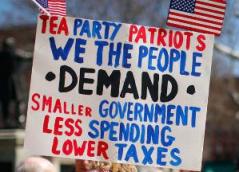
…and slavery?
A front page piece in today’s Tennessean (the daily here in Nashville) riffs off the recent publication of a book by a Christian broadcaster to explore the Tennessee presence of “Teavangelicals,” defined as “politically active conservative Christians.” The piece, headlined “Faith Drives New Political Movement,” highlights a group called the 9.12 Project Tennesseeand quotes its organizer J. Lee Douglas (who indicates he’s never heard the word “Teavangelical” but let’s not let that get in the way).
Reporter Bob Smietana conveys Douglas’s predictable far-right nostrums: government debt is immoral, same-sex marriage is sinful, and healthcare reform is unconstitutional. (That last one does seem a little tangential to the Biblical vibe, though perhaps there is some piece of the New Testament I haven’t seen that covers the commerce clause.) What Smietana doesn’t do in the piece is tell us how thoroughly retrograde the 9.12 Project Tennessee really is, to judge from its website:
We’re committed to the late 18th century American values of equal application of the law for all men and women with privilege for none.
By “late 18th century values” related to “equal application of the law,” we have to assume that the 9.12 Project Tennessee is amenable to reviving a society in which only free white men with property can vote and in which slavery is legal. Moreover, since one of the group’s core “9 principles” holds that “my spouse and I are the ultimate authority, not the government,” we might infer that the 9.12 Project Tennessee regards filicide as morally and legally acceptable.
The first of their principles reads, “America is good.” So a good American is free to own other humans as property and kill one’s offspring? One shudders to think what would make America “great.” Memo to Tennessean editors: It’s usually a good idea to look a little deeper at a fringe group one plans to feature on the front page of the paper.
This post appeared on the Nashville Scene‘s Pith in the Wind blog.
Lies, Damn Lies, and Political Campaigns
Posted: June 26, 2012 Filed under: Disgust, Politics Leave a comment
Photo: Rosmarie (Creative Commons)
This post appeared on the Nashville Scene‘s Pith in the Wind blog.
We know that high stakes political campaigns are exercises in reality distortion; when candidates go to war facts are often the first casualty. Recent election cycles have brought greater visibility for online campaign fact-check enterprises, most notably FactCheck.org, PolitiFact, and the Washington Post’s Fact Checker. Although these sites are not without their skeptics (and even harsh critics), on balance they seem to be fostering at least a smidgen of self-control on the part of candidates and handlers, who would otherwise let their surrogates and ad makers say just about anything.
At least that’s what I thought was going on until the rolling fib machine that is Mitt Romney’s campaign blossomed in all its delusive splendor. Back when he was mud-wrestling for right-wing sympathies during the bruising GOP primary season, Romney showed himself willing to say just about anything to any audience, no matter how inconsistent with his own prior views. But “opportunistic flexibility” (helpful euphemism there for the phrase that also means having the characteristics of rubbery beach footwear) isn’t the same thing as deception; with the former we know what he’s doing, and he knows that we know what he’s doing.
I suppose it qualifies as misrepresentation of one’s governing intentions if the condiment of policy slathered on a slab of red-meat rhetoric is something the candidate has no intention of pursuing. On the whole, though, we are free to be bemused by ideological agility (or flaccidity if you prefer), but it’s not something we need fact-check for accuracy or adjudicate for veracity. It is what it is, and we know what it is. We also know what it is when campaigns engage the customary political practices of tortured message framing and statistical cherry-picking (for which fact checkers routinely throw flags on both the Romney and Obama campaigns).
Lying through your teeth on verifiable matters of factual accuracy is something else entirely, and there are signs that Romney borders on the pathological. Since the first of the year, one of Rachel Maddow’s staffers has been “Chronicling Mitt’s Mendacity” on a regular basis (volume 23 appeared last Friday), enumerating dozens of falsehoods in each installment, week after week. To be fair, there are also those on the right who claim to chronicle Obama’s lies, and they work hard at it. When you compare these lists side by side you do notice that both at times fall into the trap of conflating subjective candidate statements of self-perception and identity with facts to be checked. Obama haters, for instance, think it’s a lie for Obama to describe himself as patriotic, and Romney’s detractors believe the same about a comment by Romney that he’s concerned about the poor.
When you get past this sort of partisan hectoring, you find that Romney more than any politician in recent memory cultivates a cheerfully focused willingness to make concrete assertions on factual matters that are demonstrably false. The mainstream press in the U.S. isn’t inclined to call out a major presidential candidate as a liar, but fortunately we have the foreign press also covering the race, and Michael Cohen at the Guardian isn’t quite so timid:
Quite simply, the United States has never been witness to a presidential candidate, in modern American history, who lies as frequently, as flagrantly and as brazenly as Mitt Romney. Now, in general, those of us in the pundit class are really not supposed to accuse politicians of lying – they mislead, they embellish, they mischaracterize, etc. Indeed, there is natural tendency for nominally objective reporters, in particular, to stay away from loaded terms such as lying. Which is precisely why Romney’s repeated lies are so effective. In fact, lying is really the only appropriate word to use here, because, well, Romney lies a lot.
A couple of questions are suggested by this state of affairs.
First, do we care if our elected leaders feel unencumbered by the truth? Is it disqualifying? As the fact checking sites so amply demonstrate, we tolerate a large amount of cagey and deceptive communication from candidates of all stripes, so why should the baldfaced liar concern us unduly?
Second, have these online rapid-response fact-checking operations, by shining a public spotlight on some of the candidates’ fibs, actually had the effect of diminishing the amount of campaign mendacity. This is an open empirical question, one that perhaps awaits the completion of a political science doctoral dissertation or two.
But not everyone is persuaded that the fact checkers are actually checking facts. The Weekly Standard’s Mark Hemingway, for instance, contends that what the fact checking sites are really doing is opinion checking, with prejudice. How else to explain, Hemingway wonders, a finding in a University of Minnesota content analysis that Republicans lie three times more than Democrats. How else indeed?
Actually the inference drawn by the Minnesota researchers is not that fact checkers misread opinion as fact, but rather that their choices of political messages to scrutinize suffers from selection bias: “By levying 23 Pants on Fire ratings to Republicans over the past year compared to just 4 to Democrats, it appears the sport of choice is game hunting – and the game is elephants.” Perhaps so, but then again the herd you cull is typically the fertile, populous one.


 BruceBarry.net