
On the Economic Advantages of Pointless Legislation
Posted: February 8, 2013 Filed under: Disgust Leave a comment A piece in today’s New York Times looks at efforts by state lawmakers to make it a state crime for federal agents to enforce new gun regulations. This gun-control-nullification trendlet, according to the Times, is “sweeping through statehouses from South Carolina to North Dakota.”
Tennessee, naturally, was in this game quickly. State Rep. Joe Carr of Rutherford County last month filed a bill making it a Class A misdemeanor for a federal agent to enforce any new federal regulation that restricts ownership of a semi-automatic firearm or ammunition, or requires any firearm to be registered in any manner.
And you know what? I’m for it! Oh, sure, it is of course an inane and patently unconstitutional bill that flies in the face of the U.S. Constitution’s Article VI Supremacy Clause. Granted, Tenth Amendment cultists do try to make a tortured case for its legality built on a contention that the Supremacy Clause applies only to things the federal government does that are constitutional. Since gun regulations lack constitutional validity, the thinking goes, then naturally those new federal gun laws aren’t supreme, and so the state can act to bar federal enforcement. Even Scalia’s dog won’t hunt that turkey of an argument.
But I’m for HB 42 (the Senate companion bill is SB 100) because of all the good it will do right up until the time it meets its inevitable (un)constitutional demise. First of all, just the act of litigating the constitutional issue will keep any number of lawyers, paralegals, and administrative assistants busy for months, and there sure are a lot of lawyers who need work. Also, the measure empowers the state attorney general to defend any Tennessee citizen who is prosecuted for firearms violations under new federal laws, which means more work for underemployed attorneys and better legal representation for criminal defendants. It turns out HB 42 isn’t a gun bill or a nullification bill; it’s a jobs bill!
The one question I have is why Tennessee’s gun-happy GOP lawmakers are being so timid. According to the Times story, a bill accomplishing essentially the same thing in Wyoming would allow that state to charge a federal agent with a felony punishable by five years in prison and a $5,000 fine. Apparently we’re going soft on hallucinatory crime.
A version of this post appears on the Nashville Scene‘s Pith in the Wind blog.
Hypocrite of the Week
Posted: February 1, 2013 Filed under: Policy Leave a comment The world according to Tennessee state Sen. Bill Ketron: It’s okay to let local communities make their own decisions when it comes to deciding who can sell what, but it’s not okay to let local communities make their own decisions when it comes to deciding who can employ whom.
How else to reconcile Ketron’s views on discriminating tastes with his views on discrimination? Discussing his proposed legislation allowing voters in individual municipalities to decide whether to allow wine sales in grocery stories, Ketron told a news conference that “This bill puts the decision directly in the hands of the voters, where it belongs.”
Yet Ketron cheerfully voted with his fellow state house bigots back in 2011 to pass Senate Bill 632 as a way to bar local governments and local voters from outlawing discrimination based on sexual orientation. Cloaking their anti-gay animus in a business climate pretext, the “Equal Access to Intrastate Commerce Act” was pitched as something needed to help businesses enjoy regulatory consistency. Though pushed by the Tennessee Chamber of Commerce, SB 632 was opposed by a number of large corporations.
For Ketron, selling hooch is an issue you put “directly in the hands of the voters, where it belongs.” Expanding and defending individual rights, on the other hand, is something he’d rather take from the hands of the voters, where it doesn’t belong.
A version of this post appears on the Nashville Scene‘s Pith in the Wind blog.
No-Budget-No-Pay: Cooper v. Constitution
Posted: January 21, 2013 Filed under: Politics Leave a comment When U.S. House Republicans used their Williamsburg retreat last week to retreat from an economic hostage-taking strategy and allow a three-month rise in the debt limit, they adopted a version of Democratic Rep. Jim Cooper’s “no budget no pay” scheme as an element of their new strategy. Republicans plan to include in the debt ceiling bill a provision that withholds pay from members if their chamber of the Congress fails to pass a budget by April 15.
Cooper first introduced no-budget-no-pay in late 2011 as a bill that would dock members’ pay for each day past Sept. 30 (the end of the fiscal year) that they fail to pass budget and spending bills. Lamar Alexander and Bob Corker have co-sponsored a similar measure in the Senate. But Cooper isn’t so thrilled (outwardly, anyway) to see his idea co-opted in this very public way by House Republicans. “I am sorry that it is being used now as a political weapon,” he said late last week, adding that a rise in the debt limit “should be longer than 3 months and unconditional.”
The idea may be, as Cooper has suggested, a novel and potentially effective way for Congress to take responsibility for its own bad behavior. But is it a constitutional one? With no-budget-no-pay suddenly elevated from quixotic notion to serious negotiating gambit, questions are being raised about whether it runs afoul of the 27th Amendment, which reads (in its entirety):
No law, varying the compensation for the services of the Senators and Representatives, shall take effect, until an election of Representatives shall have intervened.
Simply put, a Congress (that is, the sitting body for a given Congressional session) cannot alter its own pay. Does withholding pay amount to “varying the compensation” of members of Congress? Talking Points Memo put this question to UCLA constitutional law professor Adam Winkler, who believes it does indeed:
The answer is unclear because the 27th Amendment has never been authoritatively interpreted by the Supreme Court. Yet it seems almost certainly unconstitutional. Withholding pay effectively “var[ies] the compensation” of lawmakers. The amendment doesn’t say only raises in pay are invalid. It refers to “varying the compensation.” Just as a “bonus” would vary lawmakers’ compensation, so does withholding money. This logic applies even if the pay is ultimately delivered to lawmakers. By outlawing “varying the compensation,” the 27th Amendment prohibits laws that change when lawmakers receive pay, not just the amount they receive.
TPM quotes a House GOP leadership aide defending its constitutionality with an appeal to semantics: “The legislation does not change members’ pay. It does not reduce it.” The truth of that assertion may depend on how the thing is written. In Cooper’s original no-budget-no-pay measure (HR 3643 introduced December 2011), Congressional pay withheld could not be recouped retroactively.
So with House Republicans desperate for a way to put some fiscal heat on Senate Democrats, no-budget-no-pay may finally be poised to have its day in the sun. Alas, it may first need to have its day in court.
A version of this post appears on the Nashville Scene‘s Pith in the Wind blog.
Gun Control: The Evidence
Posted: January 4, 2013 Filed under: Policy Leave a comment In my piece on gun control in this week’s Nashville Scene, I observe that empirical evidence helps make the case for gun control. Space limitations prevented me from doing much on that point beyond mentioning the well-known fact that the U.S. is far more gun happy and far more gun-violent than other countries. So let me point more specifically here to three forms of evidence.
First, U.S. rates of gun violence vastly outpace those in other countries where firearms are more controlled and less ubiquitous. Here is a graphical view, showing that even as assault deaths in the U.S. per 100,000 population have dropped in recent decades, that rate remains far above that of essentially every OECD nation.
Second, a form of evidence I didn’t mention is the fact that over the last 30 years, the vast majority of mass shootings in the U.S. involved guns acquired legally, and most have involved precisely the kinds of weapons targeted by gun control legislation. The argument by gun rights types that the ten-year run of the 1994 so-called assault weapon ban proves the ineffectiveness of gun control is diminished by two facts: First, there is evidence that deaths from mass shootings were lower during the period the law was in effect. And second, the fact that the 1994 law was riddled with exceptions and loopholes (described in depth here) argues for better gun control, not against it. The gun lobby advocates strenuously for exceptions, and then argues afterwards that a ban can’t work because of all the exceptions? Please.
Third, sociologist Richard Florida shows that gun deaths are lower in states with stricter gun control legislation. This is illustrated in a map of the states that overlays firearm deaths above with gun control restrictions. He finds substantial negative correlations between firearm deaths and assault weapons bans, trigger lock requirements, and safe storage mandates.
As with the bulk of research on gun regulation, the evidence I cite here speaks mainly to correlation not causation. Given other things that change in the demography of violence over time, the rarity of cleanly constructed gun control legislation, and the inevitable problem of interstate weapons flow, it is virtually impossible to either demonstrate or refute causation on this subject. What we have is pretty good correlational evidence from multiple angles that firearms regulation can matter and make a difference.
For a rather different take on gun regulation and control from any offered in the Scene‘s collection of essays, check out Nashvillian John Harkey’s analysis of firearms as a public health issue akin to tobacco. Harkey advocates for “a response comparable to the tobacco crisis identified two generations ago with the 1964 Surgeon General Report.” His argument is worth a look.
A version of this post appears on the Nashville Scene‘s Pith in the Wind blog.
Lobbyists Schmobbyists
Posted: December 31, 2012 Filed under: Policy Leave a comment Winner of this month’s award for the most annoying statement by a Tennessee lobbyist: Chip Christianson, vice president of legislative affairs for the Tennessee Wine & Spirits Retailers Association, who had this to say in a Tennessean state legislature preview piece the other day on the matter of allowing wine sales in grocery stores:
“This is 100 percent pushed by the grocers. Polls, schmolls. There’s no groundswell of people trying to get this done.”
Multiple polls-schmolls have found that upwards of two-thirds of Tennesseans want this to happen, so Christianson’s view can be not-so-loosely translated as “up yours, consumers.” Look, I get it — the TWSRA represents liquor store owners, and the last thing they want to see is the competition and downward price pressure that will come with grocery store sales. (And there is empirical evidence that retail wine prices will drop with grocery store availability.)
It’s quite remarkable that a conservative state legislature continues to find it so difficult to make this happen. What principles are more bedrock conservative than letting the people have what they clearly want, by way of more rather than less market competition? House Speaker Beth Harwell sounds almost reasonable when she says “I believe it’s time for grocery stores to be allowed to sell wine — and I believe Tennesseans want that — but we want to do it in a way that creates an equal playing field for the mom-and-pop stores as well.” But where is her “equal playing field for mom-and-pop stores” vibe when big-box retailers are decimating the mom-and-pop economies of small towns and cities?
And by the way wine in grocery stores is hardly novel or adventurous. More than two-thirds of states allow this in one form or another, including such bastions of radical progressivism as Alabama, Arkansas, Idaho, Indiana, Montana, and North and South Carolina.
A version of this post appears on the Nashville Scene‘s Pith in the Wind blog.
Republicans, Guns, and Latinos
Posted: December 19, 2012 Filed under: Politics Leave a comment Since last month’s election, many in the GOP have been puzzling their way through the party’s Hispanic nightmare in electoral politics, trying to find a way to reverse President Barack Obama’s overwhelming 40-plus percentage-point landslide among the Latino vote. Now, in the wake of awful circumstances in Connecticut, comes a new surge of interest in gun control as public policy. Republicans, already working overtime to master new political tap dance routines that will avoid offending their gun lobby overlords, now get to confront this charming piece of the puzzle: Latinos love gun control!
As Adam Winkler summarizes in a Daily Beast piece this morning, polls consistently show that more and better regulation of firearms is an issue of some importance to the Hispanic electorate. A Pew Research Center poll earlier this year asked whether it’s more important to protect the rights of American to own guns or more important to control gun ownership. As the chart illustrates, Hispanic respondents were far less likely than whites (and even a bit less likely than blacks) to endorse gun rights as more important than gun control.
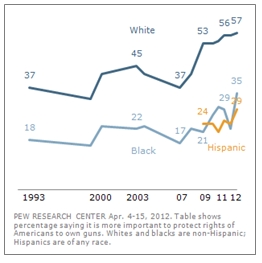 Another survey, conducted last last year by Lake Research Partners for the bipartisan group Mayors Against Illegal Guns, found that a whopping 69 percent of Latino voters want stronger laws governing gun sales, with fewer than a quarter preferring the status quo. More than 85 percent of Latinos in the survey want criminal background checks required for all gun buyers.
With Republicans also finding themselves in the 2012 election on the wrong end of a pretty significant gender gap, it is worth mentioning (even if it goes without saying) that women also favor more regulation of guns over expanded gun rights — by a margin over more than 20 percentage points in the Pew survey.
While there is nothing amusing about the circumstances that have propelled firearms back into the public policy limelight, it will be somewhat diverting to see how the GOP evolves and arranges its Latino/NRA simulpander.
A version of this post appears on the Nashville Scene‘s Pith in the Wind blog.
The Disability of Moderation II
Posted: December 17, 2012 Filed under: Politics Leave a comment I recently mentioned that Sen. Bob Corker’s supposedly moderate impulses failed to stop him from joining the unhinged right in opposition to an international treaty protecting the rights of people with disabilities. Now, in the wake of the Newtown, Conn. horror, Corker finds himself in bed with the gun loving right and its patron saint, the gun lobby.
As was widely reported over the weekend, NBC’s Meet the Press reached out to all 31 pro-gun-rights senators to invite them to share their views on the Sunday morning show, with (quoting the show’s producer) “no takers.” Bob Schieffer of CBS’s Face the Nation indicated that he, too, could find no Republicans to come on air to talk about gun control.
Corker is a member in good standing of this group of suddenly very camera shy gun-happy lawmakers. A glance at Federal Election Commission campaign finance disclosure data reveals Corker to be one of seven Republican Senate candidates on the receiving end of National Rifle Association dollars ($4,950 to be exact) during the 2012 election cycle. Our other faux moderate senator, Lamar Alexander, cheerfully accepted $9,900 of NRA largessse during the 2008 cycle. (Among Tennessee’s U.S. House members, no Democratic legislators received NRA support during the 2012 cycle, but Reps. Lincoln Davis and Bart Gordon both received NRA contributions in 2010.)
To recap, the Tennessee definition of a moderate: Advance the NRA’s agenda while opposing fair treatment of people with disabilities.
A version of this post appears on the Nashville Scene‘s Pith in the Wind blog.


 BruceBarry.net